
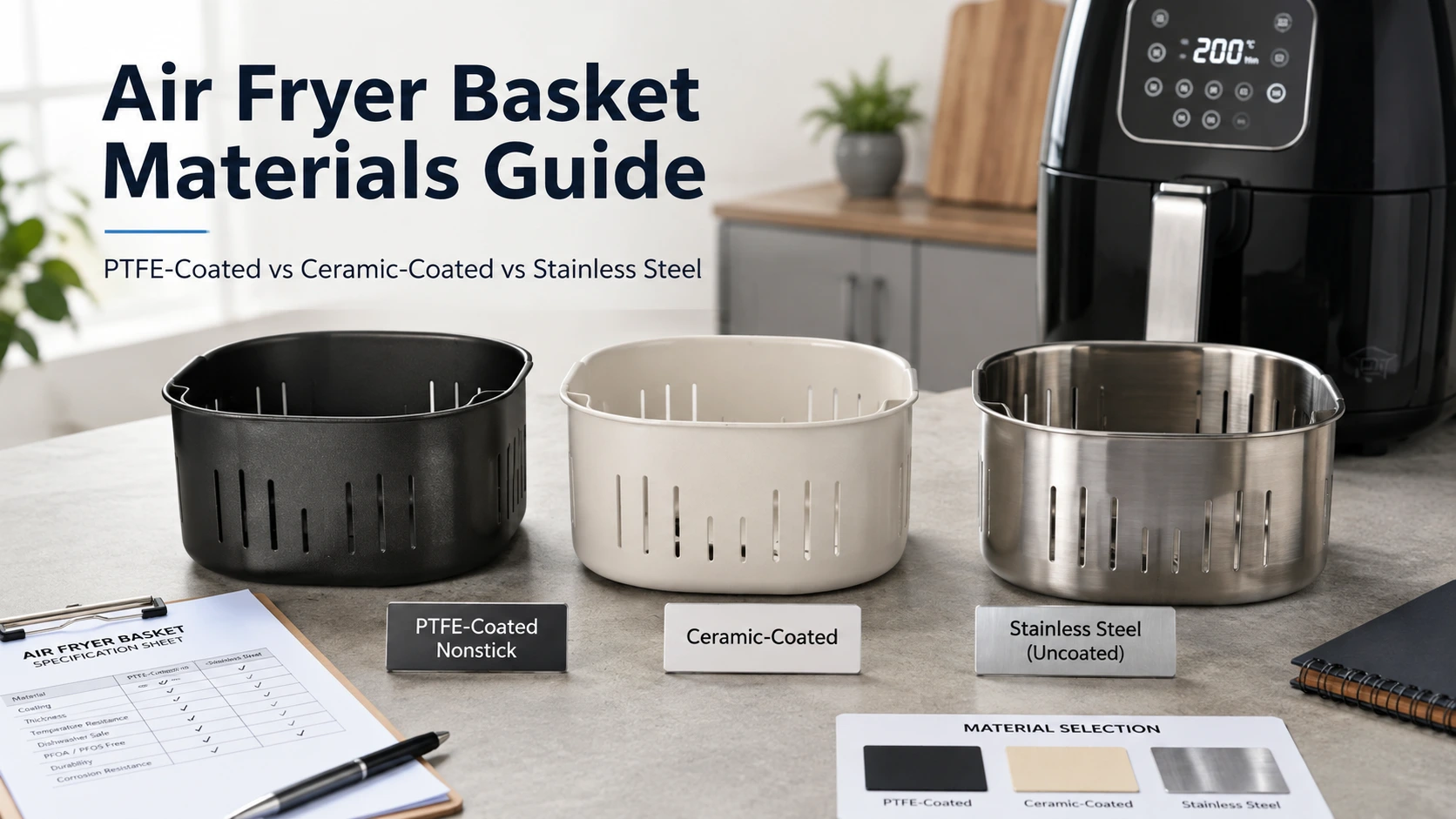
An air fryer basket material cannot be selected from a product title alone. “Nonstick,” “ceramic-coated,” and “stainless-steel interior” may describe different parts or layers. For importers and private-label buyers, the real decision is whether the full basket system fits the target market, cleaning expectations, durability requirements, compliance documents, and after-sales plan.
This guide explains how to compare air fryer coating types, verify material claims, investigate failures, and write an OEM specification that can be controlled during production.
Air Fryer Basket Material vs Coating: What Are Buyers Comparing?
Separate the Base Metal From the Food-Contact Surface
PTFE and ceramic are normally coating systems. Stainless steel is a metal that may be used as a substrate, exposed cooking surface, chamber, housing, or accessory. A coated basket may therefore contain a metal substrate, surface preparation or primer, and a food-contact topcoat.
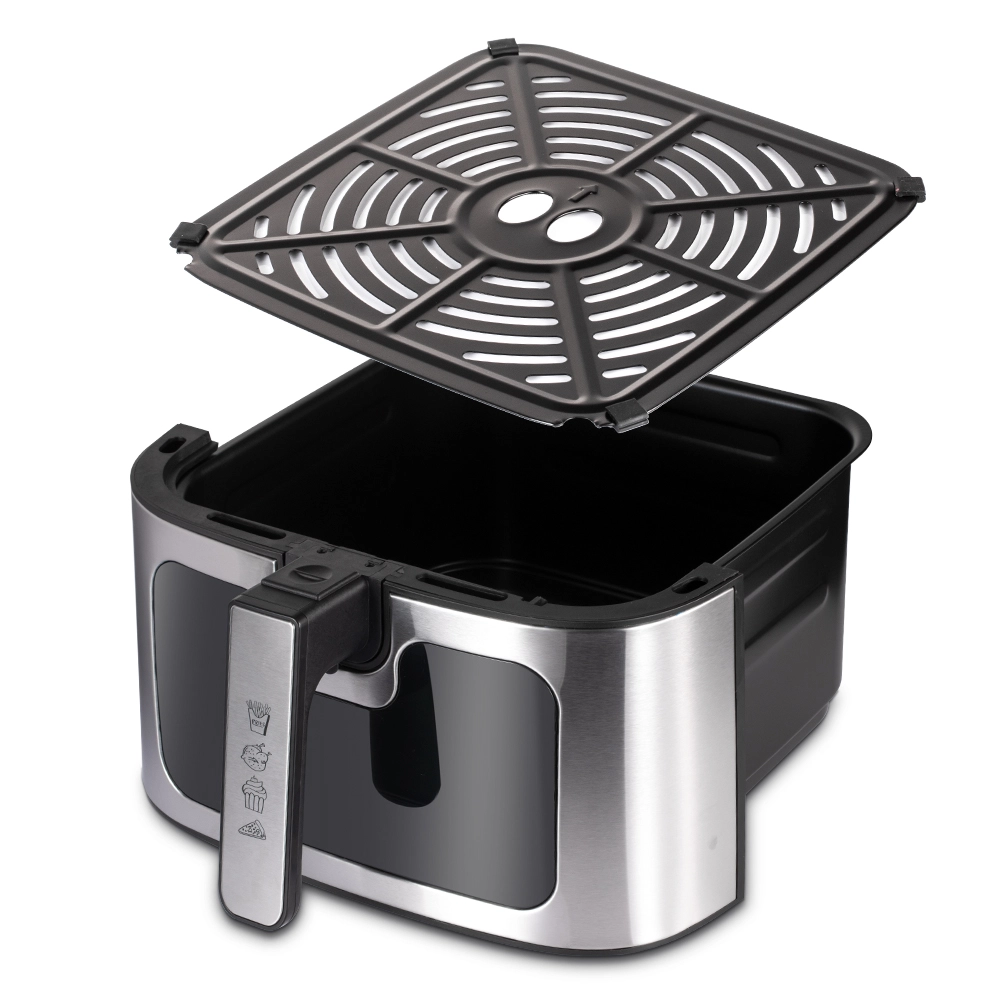
Request component-level descriptions for the basket, crisper plate, drawer, and chamber. The specification should identify the base metal, coating system, material code, supplier, and uncoated areas. “Stainless steel air fryer” is insufficient because it may refer only to the exterior.
RAF’s 8L visual air fryer with a PTFE-coated basket is described with both a PTFE nonstick coating and a stainless-steel interior and basket. It illustrates why buyers should confirm the substrate and final food-contact layer separately.
PTFE, Ceramic, and Stainless Steel Performance Compared
Performance varies with substrate preparation, coating thickness, curing, edge design, food, temperature, utensils, and cleaning. Research comparing commercial fluoropolymer and ceramic nonstick systems also shows that release and abrasion performance can change after repeated use cycles, supporting model-specific testing rather than material-name assumptions.
| Buyer Factor | PTFE-Coated | Ceramic-Coated | Uncoated Stainless Steel |
|---|---|---|---|
| Initial food release | Usually strong | Often strong when new | Depends more on food and oil |
| Coating present | Yes | Yes | No |
| Main wear concern | Scratching and edge wear | Adhesion loss or reduced release | Sticking, staining, scratching |
| Cleaning expectation | Usually easier | Often easier initially | May need soaking or brushing |
| Typical positioning | Mainstream convenience | PTFE-free positioning | Uncoated, durable positioning |
| Key evidence | Coating identity and food-contact files | Composition, claim scope, durability | Steel grade, finish, construction |
Compare Food Release, Cleaning, and User Expectations
PTFE-coated baskets are often selected when easy release and routine cleaning are central to the retail promise. Ceramic-coated baskets may support a PTFE-free position, but initial nonstick performance does not prove long-term durability. Uncoated stainless steel removes coating-flake risk but may generate complaints about sticking or more demanding cleaning.
Match the surface to the sales channel and instructions. Verify any dishwasher-safe claim for the exact coating, handle, and detachable components rather than applying it across a product family.
Compare Wear and After-Sales Risk
PTFE and ceramic coatings can be damaged by metal tools, abrasive pads, part-to-part contact, or weak adhesion at edges and perforations. Ceramic systems may lose food-release performance without visible peeling. Stainless steel cannot shed a topcoat, but it can discolor, retain residue, or scratch. Laboratory studies of cookware surfaces have found that abrasion, scouring, and scratching can materially change coated surfaces and their performance.
Compare quotations on total after-sales exposure, not coating cost alone. Review likely complaints, cleaning guidance, packaging protection, material traceability, and replacement-basket arrangements. A documented durability plan is more useful than a broad “scratch-resistant” claim.
PFOA-Free, PTFE-Free, and PFAS-Free Claims
Why the Terms Are Not Interchangeable
PFOA-free does not mean PTFE-free, and neither statement proves that a complete appliance is PFAS-free. PFOA is one chemical historically associated with some fluoropolymer production, PTFE is a fluoropolymer, and PFAS is a broader group. Each declaration needs a defined scope.
The FDA distinguishes polymerized nonstick cookware coatings from PFAS grease-proofers formerly used on paper packaging. It states that authorized nonstick coatings are applied at high temperature and that studies show negligible amounts capable of migrating to food. This does not replace model-specific review, but it shows why different PFAS uses should not be treated as one exposure scenario.
How Importers Should Verify Material Claims
For a ceramic-coated or private-label PFAS-free air fryer, ask whether the claim covers the coating liquid, cured topcoat, primer, basket, crisper plate, or all food-contact accessories. Confirm material codes, test method, analyte list, reporting limits, report date, and supplier.
A declaration for one layer may not support a claim about the whole appliance. If the supplier, color, formula, or primer changes, review the claim and evidence again. EU buyers should also avoid saying PTFE is already subject to a blanket European ban; ECHA’s broad PFAS restriction process was still progressing through scientific opinions and possible targeted derogations in 2026.
Why Air Fryer Basket Coatings Peel or Lose Performance
Manufacturing and Design Causes
Peeling can begin with inadequate substrate pretreatment, incompatible coating layers, inconsistent curing, or difficult edges and perforations. Bends, welds, basket rails, and crisper-plate contact points can concentrate wear.
Damage may also occur before sale. If removable parts rub during shipping, scratches can be present when the carton is opened. Sample approval should cover edge finish, contact points, assembly clearance, and protective packaging, not only a newly coated flat surface.
Use, Cleaning, and Complaint Diagnosis
Metal tools, abrasive cleaners, aggressive dishwasher cycles, stacking, and thermal shock may shorten coating life. Instructions should define suitable utensils and cleaning methods without unsupported lifetime promises.
For complaints, compare damage location, batch, coating code, photographs, and usage. Repeated failures at the same edge or in one batch may indicate a process or design issue; random exposed-area scratches may indicate handling. Damaged parts should be assessed against supplier guidance and market requirements rather than recoated by the user.
Food-Contact Documents Importers Should Request
All food-contact materials placed on the EU market must follow Regulation (EC) No 1935/2004 and applicable good manufacturing practice rules. Specific EU or national requirements may also apply by material.
Request the base-material and coating identity, a market-relevant food-contact declaration, supporting records where required, intended time and temperature conditions, supplier traceability, covered models and colors, and a change history.
Do not assume one air fryer coating test report covers several models because the same marketing name is used. Check photographs, drawings, substrate, coating code, process, and use conditions. Different capacities can use different tooling, edges, or suppliers.
OEM changes also need document control. A color adjustment may change the formulation; switching from PTFE to ceramic changes the system; changing the substrate may affect adhesion and migration assumptions. Update the approved sample, BOM, declarations, reports, instructions, and claims together.
Add Basket Material Requirements to the RFQ
Specify the model, basket and tray substrate, exposed surface, coating system, material code, target market, intended use, required declarations, durability expectations, cleaning claim, color, approved supplier, and permitted substitutions.
Do not accept “food-grade nonstick coating” as the complete specification. State how adhesion, abrasion, thermal cycling, cleaning, edge quality, and appearance will be reviewed. Test conditions should reflect the product requirement and agreed method rather than an unsupported universal cycle number.
Approve a golden sample with the component BOM and documents. Any change to supplier, primer, topcoat, substrate, or application process should require written review. Final inspection can find visible defects, but it cannot identify every formulation change without supply-chain traceability.
How to Choose an Air Fryer Supplier for Basket Material Options
A capable supplier should identify each food-contact component, connect it to a material code, provide model-specific documents, control substitutions, and explain the scope of PTFE-free or PFAS-free claims. It should also support investigation of recurring coating complaints.
Buyers can review RAF’s air fryer product range for importers before requesting component-level material details. The RAF company profile identifies air fryers among its household-appliance categories, while Zhejiang RAF Electric Co., Ltd. provides product and inquiry pathways for wholesale projects.
These pages establish product relevance, but model-specific verification remains necessary. Confirm the substrate, surface system, food-contact reports, claim scope, and permitted OEM changes for every selected model.
Conclusion
Air fryer basket materials should be purchased as controlled systems, not isolated marketing labels. Importers should separate substrate from coating, compare cleaning and failure risks, verify PFOA-free, PTFE-free, or PFAS-free claims, and lock approved materials before production.
Buyers can contact RAF with the model, capacity, target market, preferred surface, required documents, quantity, and sample photographs or failure concerns to identify what needs confirmation before sampling.
FAQs
Is ceramic coating better than PTFE for an air fryer?
It depends on product positioning, verified durability, cleaning expectations, and available documents. Ceramic may support a PTFE-free claim, while PTFE is often selected for easy release. Neither should be chosen without model-specific evidence.
Does PFOA-free mean an air fryer is PTFE-free?
No. PFOA-free and PTFE-free describe different substances and claim scopes. Neither statement automatically proves that the whole appliance is PFAS-free.
Is an uncoated stainless steel air fryer basket harder to clean?
It can require more soaking, brushing, or oil depending on food and surface finish. It avoids coating-flake complaints but may create sticking, residue, or discoloration concerns.
Why does an air fryer basket coating peel?
Possible causes include poor pretreatment, curing problems, edge wear, transport contact, metal tools, abrasive cleaners, or unsuitable dishwasher conditions. Failure location and batch patterns help distinguish manufacturing issues from use damage.
What coating documents should an importer request?
Request material identification, food-contact declarations, supporting reports, intended-use conditions, component coverage, supplier traceability, and change records. Every document should match the final basket, tray, substrate, coating, color, and model.


