
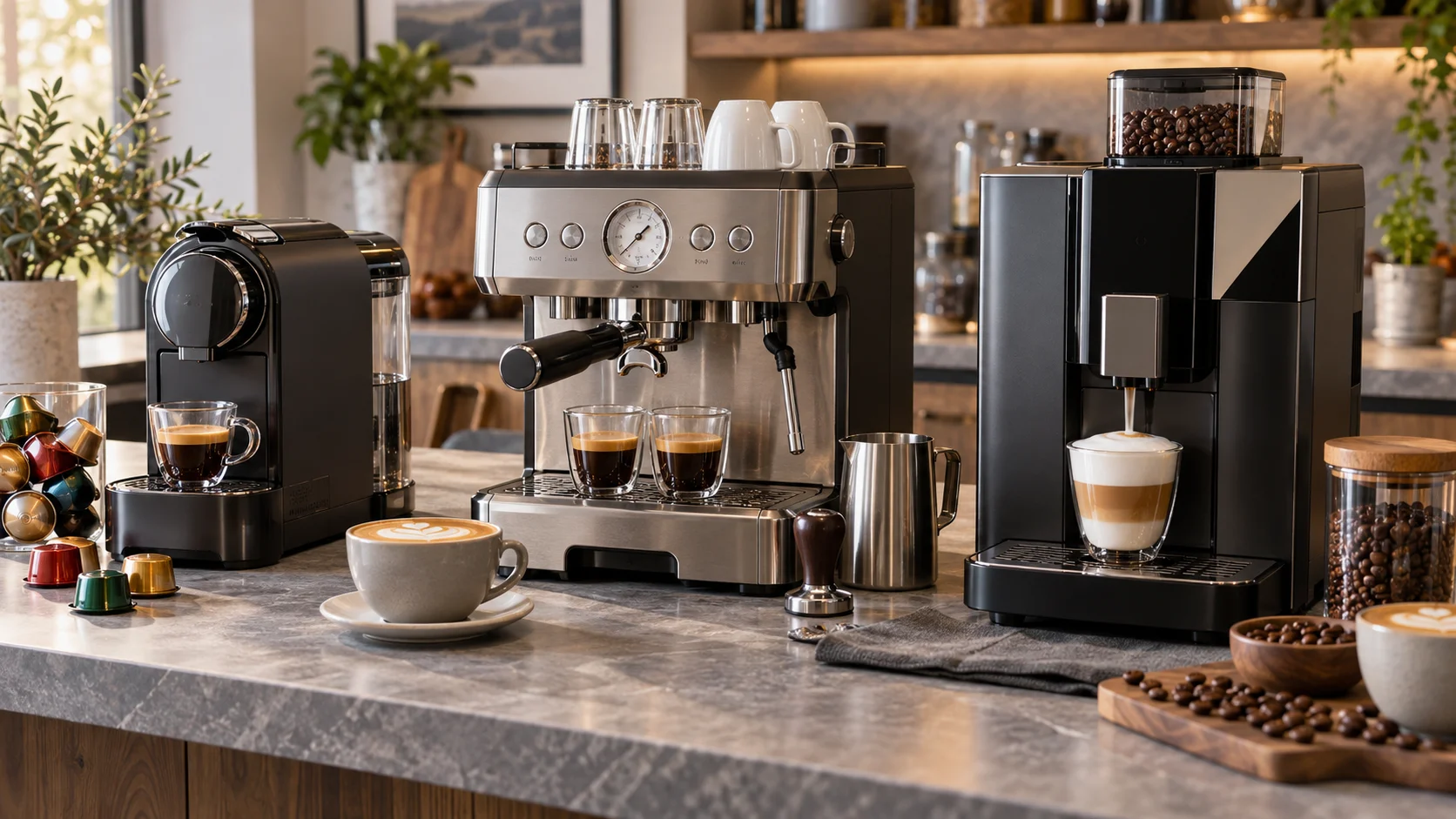
For private label brands comparing capsule vs espresso vs bean-to-cup coffee machines, the best choice supports a clear market promise and a manageable operating model. Capsule machines favor speed and repeatability. Semi-automatic espresso machines favor control and a hands-on ritual. Bean-to-cup machines favor fresh grinding with push-button convenience. Start with the target user, price tier, consumables strategy, and service capacity rather than one headline specification.
Capsule vs Espresso vs Bean-to-Cup Comparison
Choose a capsule platform when the brand proposition centers on low-friction use and a controlled drink system. Choose semi-automatic espresso when the customer values participation, milk texturing, and visible barista cues. Choose bean-to-cup when the offer needs fresh beans and automation in one product. A multi-tier portfolio can include more than one architecture, but each model should have a distinct buyer and price role.
| Decision factor | Capsule | Semi-automatic espresso | Bean-to-cup |
| User effort | Very low | High | Low |
| Beverage control | Limited by system | High | Moderate |
| Consumables | Compatible capsules | Ground coffee or beans | Whole beans |
| Cleaning burden | Low daily mess | Hands-on after use | Automated steps plus periodic deep cleaning |
| Best brand role | Convenience entry | Enthusiast upgrade | Premium convenience |
Capsule Machines Build a System Around Convenience
A capsule machine turns brewing into a short, repeatable sequence: insert a compatible capsule, select a beverage, and discard the used portion. This supports first-time users, small kitchens, hospitality rooms, and gifting programs. The compact form factor can also help a private label brand reach an accessible opening price without asking the customer to buy a grinder.
The commercial question is larger than the appliance. Capsule geometry, availability, licensing, regional supply, and recyclability claims shape the customer experience. A single system can narrow the consumables channel; a multi-capsule design broadens choice but requires careful testing. The RFQ should name supported formats and require validation with production capsules, not a generic compatibility statement.
Private label teams should also model the full relationship between appliance margin and repeat capsule purchases. If the brand will not supply capsules, the value proposition should be transparent about third-party availability. RAF’s current catalog includes a capsule coffee maker, which provides a concrete starting point for discussing this architecture and its market-specific requirements.
Semi-Automatic Espresso Creates a Hands-On Upgrade
Semi-automatic espresso machines appeal to customers who want to dose coffee, lock in a portafilter, start extraction, and often texture milk with a steam wand. That involvement creates a stronger coffee ritual and more room to adjust grind, dose, tamp, and extraction. It also raises the learning curve and makes grinder quality part of the result.
For a private label brand, this category can support an enthusiast or lifestyle position. The visible group head, pressure controls, metal finishes, cup clearance, and milk system contribute to perceived value. Yet cosmetic design should not lead the specification process. Thermal behavior, pressure stability, control logic, removable parts, and access for descaling determine whether the experience remains credible after launch.
The packaging and support plan should assume more user questions than a capsule product generates. Clear setup instructions, grind guidance, cleaning steps, and replacement-part availability reduce avoidable returns. RAF lists a semi-automatic espresso machine within its coffee machine category, allowing buyers to frame discussions around the controls, milk preparation, housing, and accessories required for their price tier.
Bean-to-Cup Combines Fresh Grinding and Automation
A bean-to-cup machine integrates the grinder, dosing path, brewing unit, and beverage controls. It gives the customer freshly ground coffee without the repeated manual steps of a portafilter machine. That combination fits premium home users, offices, and other settings where consistency and low training requirements matter.
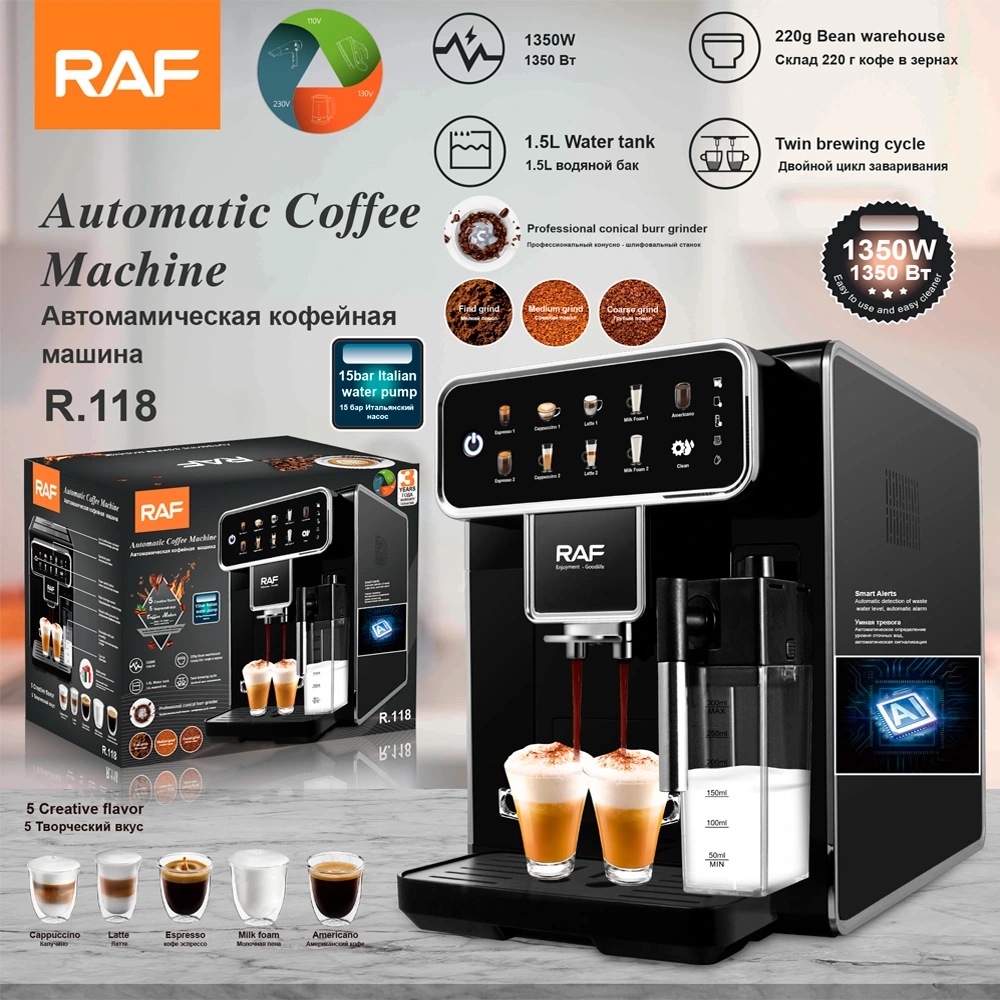
This convenience brings greater product complexity. The grinder, brew group, water circuit, sensors, software, and any milk pathway must work as one system. Evaluate noise, hopper access, adjustment range, rinse behavior, grounds-bin capacity, removable components, and error handling. A long drink menu matters only when core recipes are stable and the interface stays clear.
Service planning is especially important because faults can affect several subsystems at once. Buyers should ask which components are replaceable, what diagnostics are available, and how spare parts will be supplied. RAF currently presents an automatic bean-to-cup coffee maker in its online range, so a private label brief can begin with a real platform and then narrow the functions that the target market will actually use.
Compare the Commercial Model, Not Only the Machine
Total Cost and Margin Structure
Compare tooling, unit price, packaging, accessories, freight, testing, warranty reserve, spare parts, and consumables. Capsule products may lower the hardware barrier while shifting value toward recurring portions. Semi-automatic machines may need a grinder. Bean-to-cup models carry more components and service exposure. Compare expected cost and margin across the product’s selling life.
Customer Experience and Brand Promise
Map each architecture to a specific use case. A convenience brand should not force users through complex calibration. An enthusiast brand should not remove the controls its buyers expect. A premium convenience brand must make cleaning, alerts, and daily operation feel coherent. Product copy, photography, packaging, and support content should reinforce the same promise.
Supply Chain and After-Sales Risk
Ask how the supplier controls critical components and manages engineering changes after approval. Confirm traceability for production lots, the process for golden samples, spare-part lead times, and the format of service documentation. For capsule machines, add compatibility control. For espresso machines, add accessory consistency. For bean-to-cup machines, add software version and diagnostic control.
What to Put in a Private Label Coffee Machine RFQ
A useful RFQ turns brand strategy into testable requirements. Before comparing quotations, define the following:
- Target market and user. State the country, channel, intended buyer, daily usage pattern, and beverage expectations.
- Machine architecture. Specify capsule format, semi-automatic workflow, or bean-to-cup functions, including the required milk system.
- Electrical and compliance scope. List voltage, frequency, plug, destination-market requirements, and the documents or test reports needed before shipment.
- Customization boundaries. Separate logo, color, packaging, interface, accessories, and structural changes so each cost and lead-time impact is visible.
- Quality plan. Request sample stages, functional tests, inspection criteria, reliability expectations, and change-control procedures.
- After-sales package. Define manuals, troubleshooting content, spare parts, service training, warranty handling, and response responsibilities.
Build a Coherent Line With a Qualified Manufacturing Partner
A private label portfolio does not need every machine type at launch. One clearly positioned platform with disciplined specifications is easier to price, market, support, and improve. A second architecture should add a new customer or price tier rather than duplicate the first model with different styling.
RAF’s current coffee machine range spans the three architectures discussed here. Its published OEM and ODM services provide a path for buyers to discuss branding and product requirements. Treat every model page as the beginning of due diligence: confirm the final specification, target-market compliance, approved sample, packaging, quality controls, and service package in the purchasing documents.
Conclusion
Capsule, semi-automatic espresso, and bean-to-cup machines solve different customer problems. Capsule platforms simplify use and create a consumables ecosystem. Semi-automatic machines offer control and a visible coffee ritual. Bean-to-cup machines automate fresh grinding in a more complex product. Private label brands should choose the architecture that makes their market promise easiest to deliver consistently, then validate every commercial and technical assumption before committing to production. To discuss a market brief, expected order volume, customization scope, and sample process, contact RAF.
Frequently Asked Questions
Which coffee machine type is easiest to launch under a private label
A capsule machine often offers the simplest user journey, but launch complexity depends on capsule compatibility, market requirements, packaging, and the amount of structural customization. A standard platform with cosmetic branding is generally easier than a deeply modified product.
Is bean-to-cup always more premium than semi-automatic espresso
No. Bean-to-cup signals automated convenience, while semi-automatic espresso can signal craftsmanship and control. Premium positioning depends on the target customer, build quality, interface, beverage performance, design, and support experience.
Should a private label brand offer multiple capsule formats
Only when testing confirms reliable performance across the named formats and the market benefits from broader choice. Additional adapters or brewing paths can increase usability, but they also add parts, instructions, compatibility claims, and quality-control work.
What should be approved before mass production
Approve the final specification, golden sample, artwork, packaging, accessories, compliance documentation, inspection criteria, functional test plan, spare-parts list, and change-control process. Record every market-specific requirement in the purchase agreement.


