
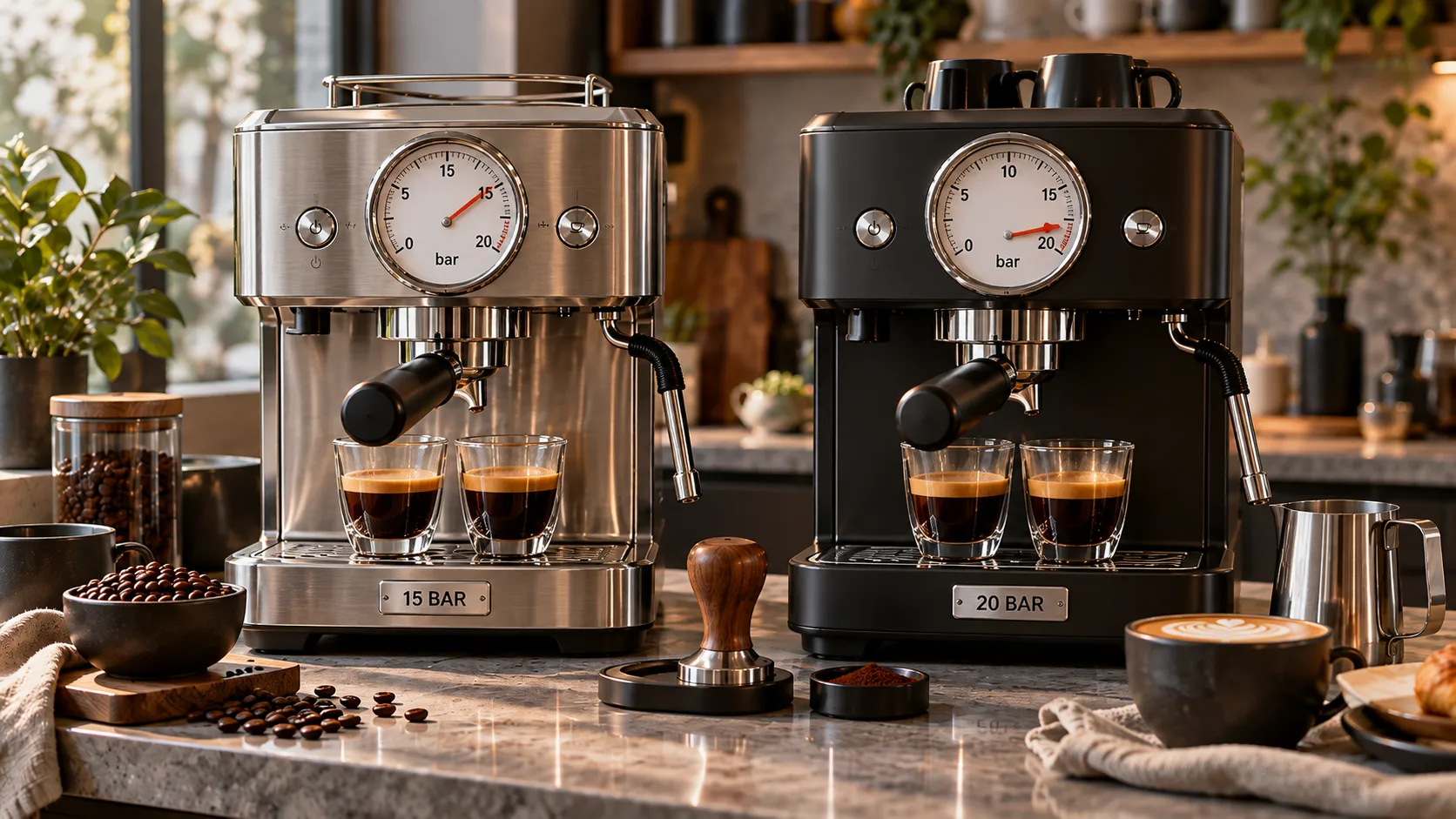
For a private label coffee machine, a 20-bar rating is not automatically better than a 15-bar rating. The number usually describes the pump’s maximum capability, while espresso quality depends on the pressure delivered at the coffee puck during extraction. A stable brew pressure, controlled flow, consistent temperature, suitable grind, and repeatable dose matter more than the largest number on the carton. Use the rating as one specification to verify, not as a stand-alone quality promise.
What the 15-Bar and 20-Bar Numbers Actually Mean
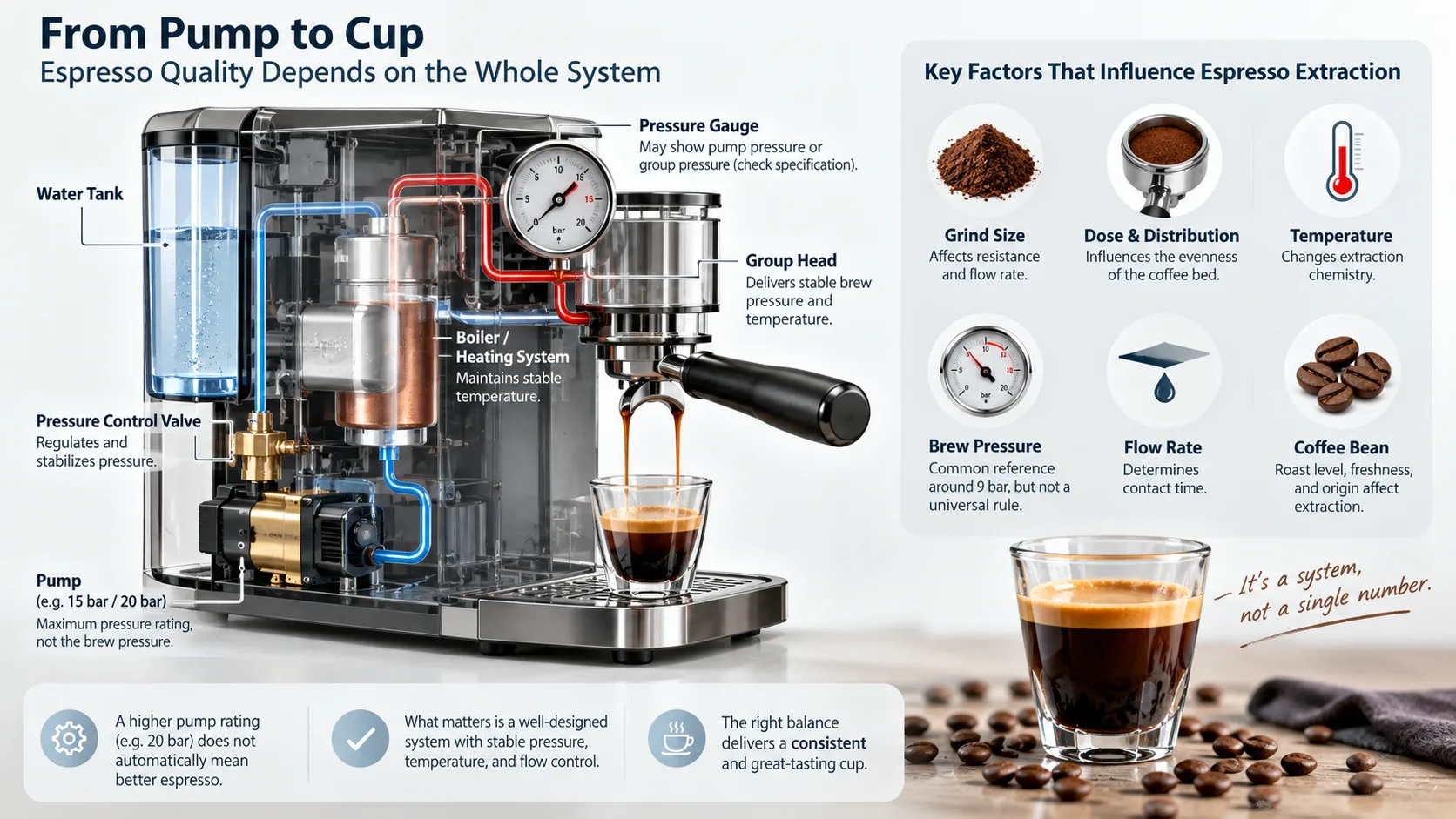
Bar is a unit of pressure. In a domestic espresso machine, the pump creates pressure so water can pass through a compact bed of finely ground coffee. A 15-bar or 20-bar label commonly identifies the pump’s upper rating under a defined test condition. It does not prove that the machine brews every shot at that pressure, nor that the puck experiences the same value.
A restriction in the portafilter, basket, coffee bed, or flow path changes the pressure measured at different points. A gauge may show pump-side pressure, group pressure, or a value influenced by a blind filter test. For a buyer comparing private label platforms, the meaningful question is: what pressure and flow profile does the machine deliver at the group during a real coffee extraction, and how is that behavior controlled?
This distinction explains why two machines with different pump ratings can produce similar cups. It also explains why a higher rating can create risk when the rest of the hydraulic design, over-pressure protection, or recipe control is not matched to the target coffee.
Why More Pressure Does Not Guarantee Better Espresso
Extraction is a system, not a single number
Espresso is sensitive to several variables at once. Grind size changes resistance; dose and distribution affect the thickness and uniformity of the coffee bed; temperature changes extraction chemistry; flow determines contact time; and the coffee’s roast and age change how water moves through it. If these variables are unstable, increasing the pump ceiling will not correct the underlying problem.
Excess pressure can make inconsistency harder to diagnose
When pressure rises too quickly, a weakly prepared puck may channel, allowing water to find low-resistance paths. The result can be uneven extraction rather than a richer cup. A pressure-control valve, a well-designed group, and a gauge that reflects useful brew conditions give a product team more practical control than a headline rating alone. Claims such as “deeper crema” or “cafe-level quality” should therefore be tied to a defined test method, not inferred from 20 bar.
The 9-bar reference point
Many espresso recipes use a brew-pressure target around 9 bar as a reference, but it is not a universal rule for every coffee, basket, or profile. Some machines are designed to start lower, ramp pressure, or vary flow. The procurement requirement should describe the intended operating range and adjustment method rather than demand a number without context.
15 Bar vs 20 Bar: A Practical Private Label Comparison
- 15-bar platform. A 15-bar pump can be a sound choice when the machine has an effective pressure-limiting design, stable heating, and a recipe that suits the target user. It may support a clear value proposition without encouraging buyers to equate maximum pump output with cup quality.
- 20-bar platform. A 20-bar pump provides more headroom at the pump, but the extra capacity only adds value when the hydraulic circuit, protection system, and brew controls use it responsibly. It can be relevant for a product brief that requires a particular pressure range, gauge behavior, or future recipe flexibility.
- What should decide the choice. Compare measured brew pressure, pressure stability, temperature recovery, flow behavior, noise, leakage protection, service access, and repeatability on the intended coffee. The lower headline rating is not a defect, and the higher rating is not a guarantee.
How to Specify Pressure for a Private Label RFQ
A useful RFQ converts pressure language into acceptance criteria. Ask the supplier to define where pressure is measured, which test device is used, whether the reading is static or dynamic, and what tolerance applies. Request extraction tests with the agreed basket, dose, grind range, water temperature, and shot time. A pressure gauge should be assessed for readability and relevance, not simply added as a visual feature.
- Hydraulic controls. Confirm the pump type, over-pressure valve, relief behavior, flow path, and the conditions that trigger protection.
- Thermal performance. Specify the heating architecture, temperature control method, warm-up expectations, recovery between shots, and steam-versus-brew priorities.
- Recipe repeatability. Define the dose, grind, beverage volume, target time, and acceptable pressure and temperature variation across samples and production units.
- Service and documentation. Request exploded views, troubleshooting steps, replacement parts, calibration guidance, and a change-control process for the pump or control board.
How RAF Models Fit the Pressure Discussion
RAF’s coffee-machine range includes several architectures, so a private label brief can start with the customer experience and then select the appropriate platform. The published R.136 is described as a semi-automatic espresso machine with a 15-bar pump, while R.0207 is presented as a semi-automatic model with a 20-bar pump and dual-boiler configuration. Those figures are useful starting points for an RFQ, but the final specification should verify dynamic brew pressure, temperature behavior, and protection settings on the approved sample.
A buyer evaluating automation can also review RAF’s published R.0200 smart bean-to-cup platform, which combines whole-bean grinding and automatic beverage preparation. Its value is not determined by a pump number alone; grinder consistency, brew-unit access, software behavior, cleaning cycles, and spare-part planning become equally important. The broader RAF coffee machine category helps frame the available product architectures before a brand narrows the brief.
Supplier Checks Beyond the Pump Rating
Before approving a model, request the technical drawing, electrical version, materials list, safety documentation, golden sample, packaging artwork, and inspection plan. Confirm that the pressure claim appears consistently on the product, manual, carton, and online listing. If the brand will sell in several regions, align voltage, plug, labeling, and required testing before tooling or mass production.
Ask how the supplier handles engineering changes to the pump, valve, boiler, gasket, firmware, and user interface. For a private label launch, a lower-cost change that alters pressure behavior can create returns and inconsistent marketing claims. A documented approval process protects the brand more effectively than a larger bar figure.
RAF’s OEM and ODM service page gives buyers a route to discuss branding, customization, and platform fit. Use that conversation to align pressure tests with the target recipe, market, packaging, and after-sales plan rather than asking for a generic “high-pressure” machine.
Conclusion
For most private label decisions, 20 bar is not automatically better than 15 bar. The pump rating describes available capacity; the cup reflects the complete extraction system. Choose the platform that delivers a controlled, repeatable brew at the intended operating point, then verify pressure, temperature, flow, safety, and serviceability with documented tests. To review a model, target market, customization scope, and sample plan, contact RAF’s technical team with those requirements in writing.
Frequently Asked Questions
Is 15 bar enough for espresso?
It can be. A 15-bar pump may provide adequate capacity when the machine regulates pressure and the recipe, basket, temperature, and flow are well matched. Verify dynamic brew behavior rather than relying on the label.
Does a 20-bar machine extract more crema?
Not necessarily. Crema depends on coffee freshness, grind, dose, pressure profile, temperature, and flow. A higher maximum pump rating alone does not establish a better result.
Should an RFQ require exactly 9 bar?
Require the pressure range and test method that fit the intended recipe. Around 9 bar is a common reference, but the correct acceptance window depends on the machine design and coffee program.
What is more important than the bar rating?
Prioritize pressure stability, temperature control, flow management, grinder and dose consistency, user controls, protection systems, cleaning access, and service documentation.


