
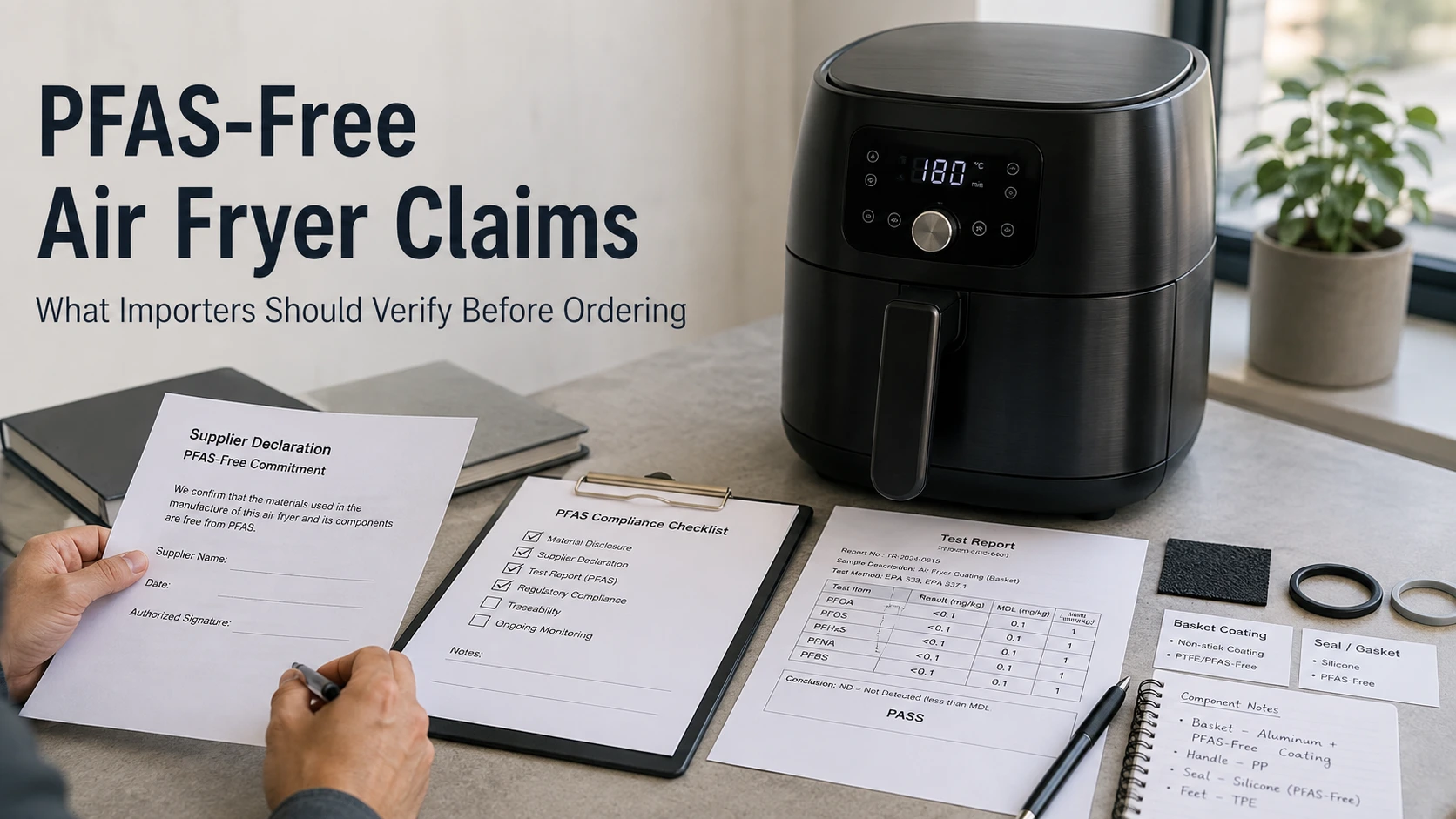
A PFAS-free air fryer claim can refer to one coating, one food-contact component, or an entire product. Those claims are not equivalent. Importers and private-label buyers must define what “PFAS-free” means for the order, identify every covered component, and verify that the supplier documents and test reports match the final model.
A simple statement such as “ceramic coating” or “PFOA-free” does not provide enough information for product approval, packaging claims, or marketplace listings. Verification should begin before quotation approval and continue through sampling, mass production, and shipment.
Define Exactly What the PFAS-Free Claim Covers
Before requesting a laboratory report, determine the claim that the product is expected to support. Testing without a defined claim can produce technically valid results that are unsuitable for the intended marketing language.
Separate PFOA-Free, PTFE-Free, and PFAS-Free Claims
PFOA, PTFE, and PFAS describe different things. PFOA is one specific substance, PTFE is a fluoropolymer commonly associated with nonstick applications, and PFAS refers to a much broader chemical group.
A PFOA-free statement does not establish that a coating is PTFE-free. Similarly, PTFE-free does not automatically prove that every primer, pigment, seal, accessory, or other food-contact component contains no intentionally added PFAS.
The RFQ should therefore state whether the requested claim is:
- free from intentionally added PFAS;
- PTFE-free on identified food-contact surfaces;
- PFOA-free within a defined coating formulation; or
- “no listed PFAS detected” under a specified test method and reporting limit.
These statements should not be used interchangeably. The permitted packaging and online wording must reflect what the evidence actually supports.
The FDA also distinguishes polymerized nonstick coatings from PFAS grease-proofing agents formerly used on paper packaging. Its current information states that authorized polymerized nonstick coatings are applied at high temperatures and contain negligible amounts capable of migrating to food. This distinction matters because different PFAS applications should not be treated as one exposure or regulatory scenario.
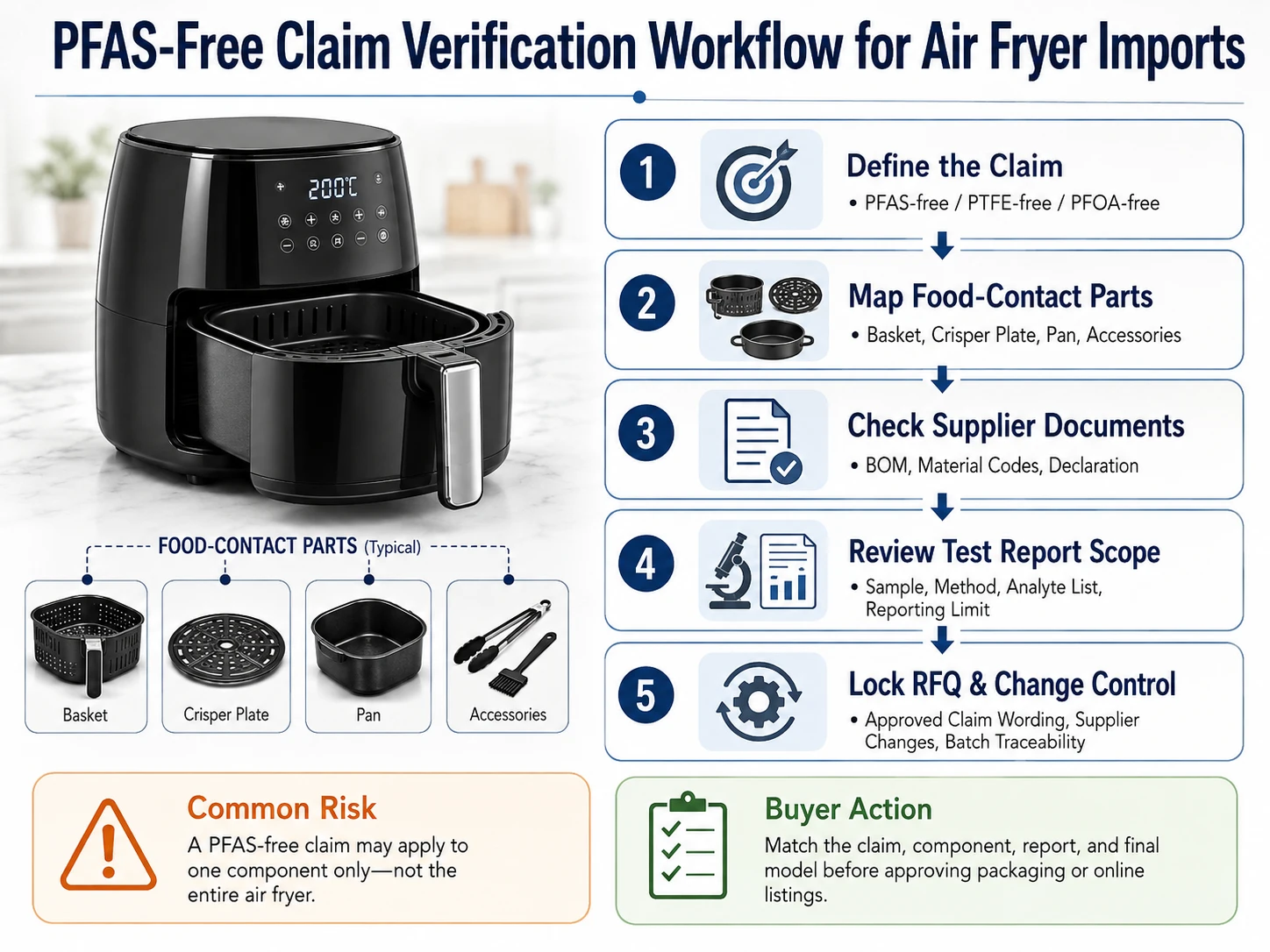
Map Every Air Fryer Part Included in the Claim
A PFAS-free claim should be linked to a component map. Depending on the design, relevant parts may include:
- the frying basket;
- the crisper plate;
- the drawer or cooking pan;
- racks, trays, skewers, and accessory molds;
- seals or gaskets that contact food;
- the inner chamber; and
- primer, topcoat, paint, or decorative layers on food-contact surfaces.
Testing only the basket does not automatically support a whole-product PFAS-free claim. A stainless steel or glass cooking chamber also does not prove that the crisper plate, accessory coating, seal, or other food-contact part is free from intentionally added PFAS.
Maine’s current implementation guidance illustrates why component scope matters. Its cookware definition includes electric products such as air fryers when a surface containing intentionally added PFAS contacts food. Internal components that do not contact food are treated differently under the state’s 2026 cookware prohibition.
Ask the manufacturer for a labeled component drawing and BOM showing each material code, coating system, and food-contact location.
Check PFAS Requirements in the Target Market
A global claim should not be approved from a single country’s requirements. Importers need a market matrix covering destination countries, U.S. states, sales channels, and planned product claims.
Distinguish U.S. State Rules From Federal Food-Contact Requirements
U.S. federal food-contact requirements and state product prohibitions address different questions. FDA authorization concerns the intended food-contact use and migration of substances. State laws may prohibit the sale of product categories containing intentionally added PFAS even when a material has an authorized federal food-contact use.
Maine’s 2026 prohibition covers cookware with intentionally added PFAS on food-contact surfaces and specifically identifies air fryers as an example. Minnesota has prohibited cookware containing intentionally added PFAS since January 1, 2025, while distinguishing products in which PFAS occurs only in electronic or internal components.
Importers should record:
- each state where the product will be offered;
- whether the restriction applies to the food-contact surface or broader product;
- who is treated as the manufacturer or importer;
- what documentation must be retained; and
- whether planned claims go beyond the minimum legal requirement.
A state requirement should not be described as a nationwide U.S. prohibition.
Treat the EU Restriction as a Developing Requirement
EU food-contact materials must comply with the general framework under Regulation (EC) No 1935/2004 and applicable good manufacturing practice and material-specific requirements.
The proposed broader EU PFAS restriction was not final as of August 2026. ECHA’s Risk Assessment Committee adopted its final opinion in March 2026, while the Socio-Economic Analysis Committee issued a draft opinion and consulted stakeholders. The final SEAC opinion was expected by the end of 2026 before the European Commission’s subsequent decision process.
For EU orders, RFQs should require compliance with the rules applicable at market-entry time and require notification when legal changes affect the coating or claim.
Request the Right PFAS Evidence From the Manufacturer
Evidence should be collected in layers. A supplier declaration describes the formulation and intent, while testing provides results for a defined sample and method. Neither is useful if it cannot be linked to the ordered model.
Request a Supplier Declaration, Component BOM, and Coating Identity
The supplier declaration should identify:
- the legal manufacturer and signatory;
- product and model numbers;
- covered components;
- substrate, primer, and topcoat codes;
- coating and component suppliers;
- applicable colors and capacities;
- whether PFAS are intentionally added;
- the exact meaning of PFOA-free, PTFE-free, or PFAS-free;
- issue date and document version; and
- notification requirements for formulation or supplier changes.
“Food grade” is not an adequate chemical declaration. It does not identify the formulation, applicable market, supporting standard, or component coverage.
The BOM should match the approved sample. If the basket and crisper plate use different coating codes, both must be evaluated. If the primer identity is missing, the statement may cover only the visible topcoat.
Read the Test Report Beyond the Final Result
A PFAS test report should be reviewed for more than the words “pass” or “not detected.”
| Report Field | What the Buyer Should Confirm |
|---|---|
| Sample description | Exact basket, plate, coating, or finished product tested |
| Model and photographs | Match the quotation and approved sample |
| Material code | Match the supplier declaration and BOM |
| Test method | Appropriate for the intended claim |
| Analyte list | Shows which PFAS were actually measured |
| Reporting limits | Defines what “not detected” means |
| Applicant and manufacturer | Match the transaction and supply chain |
| Date and laboratory | Current and identifiable |
| Conclusion | Does not exceed the scope of the results |
A “not detected” result means that the listed substances were not found above the method’s reporting limits in the tested sample. It does not prove that every PFAS is absent.
Testing a liquid coating may not represent the cured basket. Testing one finished basket may not cover a different color, primer, coating supplier, or crisper plate. Any mismatch should lead to a technical explanation, supplementary evidence, or new testing before approval.
Match the Test Method to the Claim
Targeted PFAS testing measures a defined list of substances. It can support a claim limited to that list and method, but not a universal statement that no PFAS exists.
Total fluorine analysis answers a different question. FDA notes that it detects fluorine but cannot distinguish PFAS from other fluorine-containing substances. Highly sensitive tests may also detect impurities or environmental contamination even when PFAS were not intentionally used.
The test plan should therefore be selected with a qualified laboratory or compliance specialist based on:
- the intended claim;
- applicable market rules;
- the material and coating chemistry;
- the component being tested; and
- whether the objective is formulation verification, screening, or regulatory evidence.
Verify That the Evidence Matches the Exact Order
Even a genuine report may be irrelevant if it covers another model or material version.
Match the Model, Component, Color, and Material Code
Compare the supplier declaration, report, BOM, golden sample, specification, and purchase order. The same model number should appear throughout, or the manufacturer should provide a documented relationship between tested and commercial variants.
Color changes may involve different pigments or formulations. Different capacities may use separate tooling, basket suppliers, or coating lines. The use of the same marketing name—such as “ceramic nonstick”—does not demonstrate identical chemistry.
One report may cover a product family when the manufacturer can show technical equivalence across the substrate, primer, topcoat, supplier, application process, and intended use. Without this explanation, each variation should be assessed separately.
Put PFAS-Free Requirements Into the RFQ and Purchase Order
PFAS requirements should be written before suppliers quote. Otherwise, competing quotations may include different materials, testing scopes, and document responsibilities.
Define the Claim and Required Documents
The RFQ should specify:
- target countries and U.S. states;
- exact proposed marketing claim;
- covered food-contact components;
- basket and plate substrate;
- primer and topcoat material codes;
- coating supplier;
- intentionally added PFAS declaration;
- required test scope and report delivery date;
- approved claim wording;
- permitted substitutions;
- retest triggers;
- batch-traceability requirements; and
- responsibility for testing costs and updates.
This allows several manufacturers to quote against the same specification rather than interpreting “PFAS-free coating” differently.
Approve the Sample, Evidence, and Claim Wording Together
The golden sample should be linked to the BOM, coating codes, supplier declaration, reports, packaging artwork, and online claim.
If the report covers only the basket surface, avoid describing the entire appliance as PFAS-free. A more precise claim may refer to identified food-contact surfaces or the absence of intentionally added PFAS within the documented component scope.
Private-label brands should approve claim wording through their compliance or legal process before printing cartons or publishing marketplace listings.
Control Material Changes During Production
The purchase order should prohibit unapproved substitutions of the substrate, primer, topcoat, color formulation, coating supplier, or application process.
A first-sample report does not prove that every later batch uses the same material. Risk-based batch testing may be appropriate when required by the market, contract, claim, or history of supplier changes. Incoming records and production traceability remain necessary because final visual inspection cannot identify every chemistry change.
How to Evaluate a PFAS-Free Air Fryer Manufacturer
A suitable manufacturer should provide component-level transparency, readable evidence, material-code control, batch traceability, and written change notification. It should also avoid presenting “ceramic,” “PFOA-free,” or “non-toxic” as interchangeable claims.
Importers can review an air fryer product range for importers to identify candidate configurations, but PFAS evidence must be requested for each selected model. RAF publicly lists multiple air fryer formats and models, while the RAF company profile identifies air fryers among Zhejiang RAF Electric Co., Ltd.’s household appliance categories.
The public product range demonstrates business relevance, not verified PFAS-free status. Before using any RAF model for a PFAS-free private-label project, buyers should confirm the exact food-contact components, coating codes, supplier declarations, report scope, and permitted OEM changes with Zhejiang RAF Electric Co., Ltd.
Conclusion
PFAS-free air fryer claims require a defined statement, component map, market review, supplier declaration, suitable test report, and controlled production specification. Importers should verify the exact model and material version before approving packaging or online claims.
Buyers can contact RAF with the target markets, product model, expected claim, food-contact component list, material preference, quantity, and existing reports to determine which information still requires confirmation.
FAQs
Does PFOA-free mean an air fryer is PFAS-free?
No. PFOA is one substance within the broader PFAS category. A PFOA-free statement does not prove that the coating is PTFE-free or that other PFAS are absent.
Is a ceramic-coated air fryer automatically PFAS-free?
No. The ceramic topcoat, primer, pigments, seals, accessories, and other food-contact parts must be reviewed. The claim should be supported by component-specific declarations and suitable testing.
What parts of an air fryer should be checked for PFAS?
Review the basket, crisper plate, cooking pan, racks, trays, food-contact seals, coated accessories, and any other surface that directly contacts food during normal use.
Can one PFAS test report cover several air fryer models?
Possibly, when the manufacturer documents that the models use the same substrate, coating system, material codes, suppliers, manufacturing process, and intended conditions. Otherwise, additional assessment may be needed.
Does changing the coating color require a new review?
Yes, at least a document review. A color change may introduce different pigments, additives, formulations, or material codes. The scale of the change determines whether supplementary testing is needed.


