
Choosing the correct air fryer size is a sourcing decision, not just a matter of product description. The capacity of the air fryer influences retail positioning, packing size, price, end-user satisfaction, and after-sales risk management for importers, distributors, retail brands, and OEM buyers. This air fryer size guide for importers will help you choose the most suitable capacity of the air fryer before submitting an RFQ.
Quick Answer: Which Air Fryer Size Should Importers Choose?
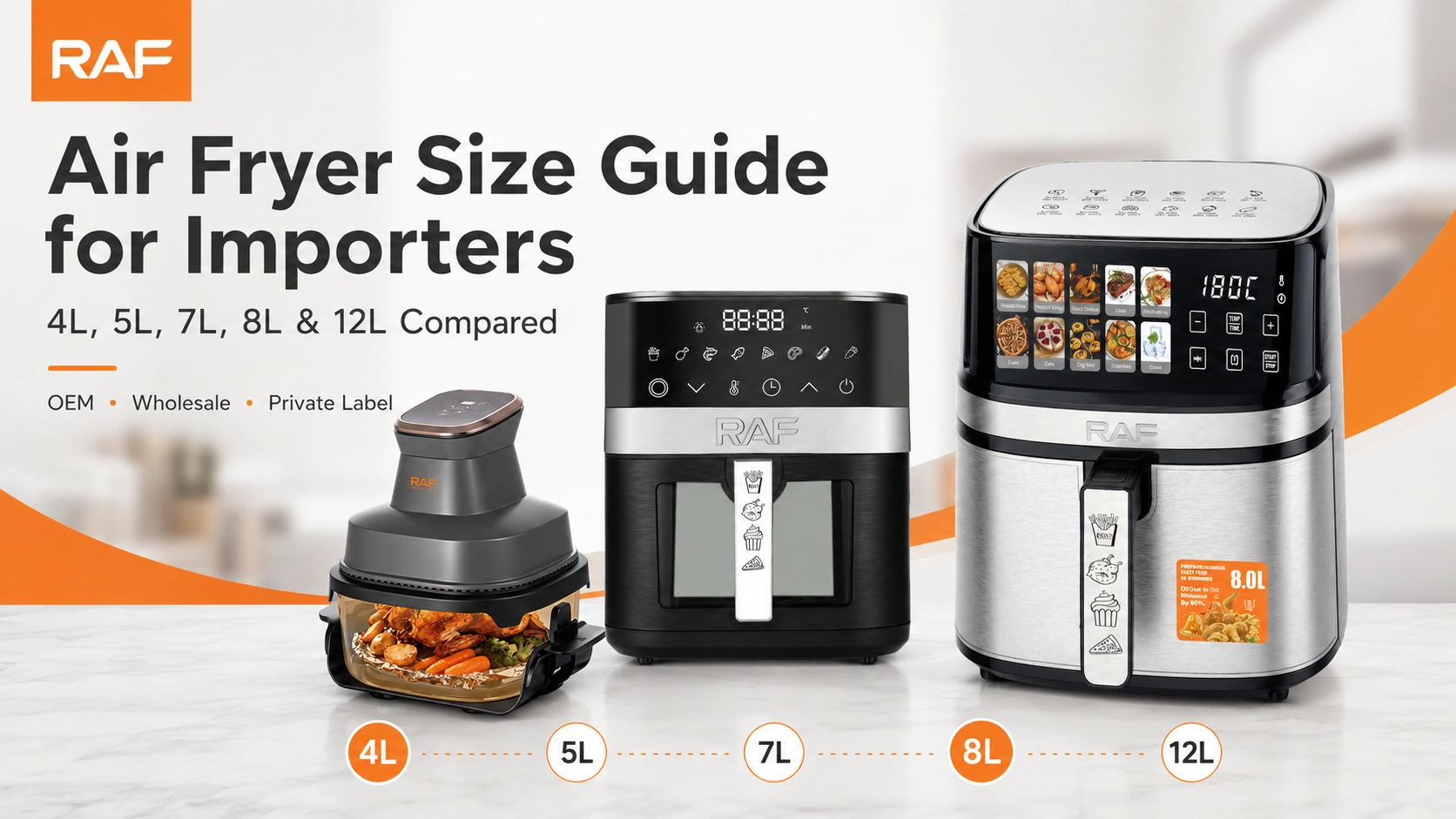
A 4L air fryer is suitable for compact kitchens, small households, and price-sensitive retail programs. A 5L air fryer is usually easier to position as a mainstream volume model because it can serve daily family use without becoming too large for storage or display. A 7L or 8L air fryer fits buyers targeting family-size retail channels, while a 12L or 6L+6L dual-basket air fryer is more suitable for premium private label projects, large-family promotions, or retailers that need a clear product difference.
The right choice depends on the target market, retail price band, plug and voltage requirements, packaging limits, and whether the buyer needs single-basket or dual-basket positioning.
Air Fryer Capacity Comparison Chart: 4L, 5L, 7L, 8L and 12L
| Capacity | B2B Positioning | Suitable Buyer Type | Key Point to Verify |
| 4L | Compact entry-level model | Discount retailers, online sellers, small-apartment markets | Usable basket space |
| 5L | Mainstream volume model | Importers, distributors, private label starters | Price, design, control method |
| 7L | Family upgrade model | Appliance retailers, regional distributors | Basket size and carton dimensions |
| 8L | Large family model | Mid-range retail and e-commerce channels | Power, airflow, packaging strength |
| 12L / 6L+6L | Premium dual-basket model | Private label brands and high-ticket retail | Independent control, QC, after-sales parts |
RAF’s air fryer product category includes multiple capacity options, including 5L, 7L, 8L, 12L, and dual-basket air fryers, which allows buyers to compare different structures before narrowing the model list.
4L and 5L Air Fryers: Entry-Level and Mainstream Models
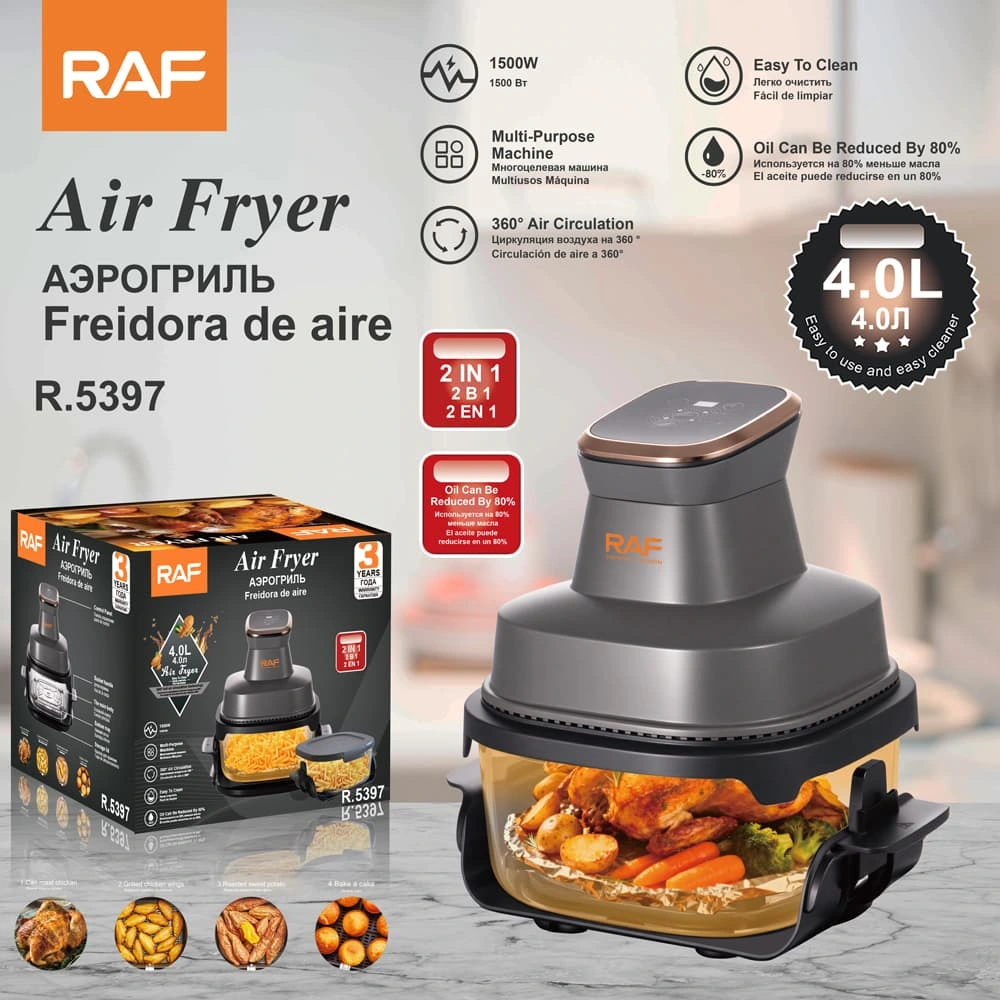
A 4L air fryer works best when the buyer needs a compact, simple, and affordable model for small households or first-time users. It is not the strongest option for family-size cooking or channels where buyers expect larger baskets. RAF product information includes 4.0L drawer-type and knob-control air fryers, with mechanical or touch control options depending on the model.
A 5L air fryer is usually a stronger starting point for bulk orders. It can support broader household demand while keeping the product easier to price, pack, and promote. For importers testing a new air fryer category, 5L can reduce the risk of selecting a size that is too small for general retail use or too large for entry-level buyers.
7L and 8L Air Fryers: Family-Size Retail Models
A 7L or 8L air fryer is more suitable when the market expects larger meal portions, stronger shelf appeal, and a visible upgrade from compact appliances. These sizes can work well for appliance stores, family-use e-commerce listings, and distributors that need more than one retail tier.
Before placing a bulk order, buyers should verify the basket shape, heating power, control panel, outer carton size, and packaging protection. A larger claimed capacity does not automatically mean better cooking performance. The actual food load may vary by basket depth, tray shape, airflow path, and how much space is needed for hot air circulation.
12L / 6L+6L Air Fryers: Premium Dual-Basket Models
A 12L air fryer or 6L+6L dual-basket air fryer is better suited to premium retail programs. RAF product materials describe double-basket air fryers with independent cooking areas, allowing two types of food to be prepared at the same time. This structure can reduce batch cooking for end users and create a stronger sales point for retail packaging.
However, larger dual-basket models require more careful sourcing checks. Importers should review heating performance, control logic, basket coating, handle structure, carton strength, and spare parts availability. A 12L model can improve perceived value, but it may also increase shipping volume, storage pressure, and after-sales complexity.
Why Air Fryer Capacity Decisions Go Wrong in Bulk Orders
Claimed Liters Are Not Always Usable Cooking Capacity
One common sourcing mistake is comparing air fryers only by the liter number in the product title. Actual cooking capacity may depend on basket width, depth, rack design, and food placement. A deep basket may have a large stated capacity but limited flat cooking area. A dual-basket model may offer large total capacity but split the space into two zones.
Importers should test sample units with realistic foods from the target market, such as fries, chicken wings, fish, vegetables, or flat foods. This helps confirm whether the product fits the intended retail claim and reduces the risk of customer complaints after launch.
Basket Shape and Airflow Affect Real Food Load
Basket shape affects how evenly food can be heated. Square baskets may provide more usable flat space, while narrow deep baskets may require smaller food loads to maintain airflow. Dual-basket models add flexibility, but each basket should be evaluated separately.
Buyers should ask for product specifications covering capacity, basket dimensions, rated voltage, power, control method, temperature range, timer design, material, plug type, and packaging details. These points are more useful than relying on capacity alone.
How to Match Air Fryer Size to Sales Channel and Target Market
Suitable Size Mix for Online Sellers and Cross-Border Retailers
Online sellers need models that are easy to explain through product images, comparison tables, and short selling points. A practical structure may use 5L as the core SKU, 7L or 8L as the family upgrade, and 12L dual-basket models as premium listings. This gives the store several price levels without making the product range too complex.
Buyers comparing air fryers with other RAF small kitchen appliances can also review related kitchen categories to build a broader household appliance catalog for the same sales channel.
Suitable Size Mix for Supermarkets and Appliance Distributors
Supermarkets and appliance distributors usually need clearer shelf segmentation. A 4L or 5L model can serve entry-level shoppers, 7L and 8L models can support family-size demand, and 12L dual-basket models can be used as higher-value display products.
For these channels, packaging matters as much as product capacity. Buyers should confirm color box size, outer carton structure, barcode requirements, manual language, plug type, and local compliance requirements before confirming the final model.
What Specifications Should Importers Check Before Choosing Capacity?
Power, Voltage and Plug Configuration
Air fryer size should be reviewed together with power, voltage, frequency, and plug configuration. RAF product materials include 220V or 220–240V household appliance designs and European plug options across many products. Still, the exact configuration should always be verified against the selected air fryer specification and destination market requirements.
Compliance, Packaging and Inspection Requirements
Importers should check required documents, labeling, packaging artwork, carton marks, inspection standards, and sample approval steps before mass production. Larger models, especially 8L and 12L air fryers, should be checked for packaging protection because carton damage can create avoidable returns and customer complaints.
OEM, Logo, Gift Box and Manual Customization
Private label buyers should confirm logo position, rating label content, gift box artwork, instruction manual language, barcode, and outer carton information. These details affect customs clearance, retail display, and after-sales communication. They should be confirmed before sample approval, not after production begins.
Supplier Selection Checklist for Wholesale Air Fryer Orders
Questions to Ask Before Sending an RFQ
A useful RFQ should include target capacity, basket type, control method, quantity, voltage, plug type, certification market, packaging requirements, logo needs, manual language, sample request, and target sales channel. Without these details, a supplier can only provide a general quotation, which may not match the real purchasing project.
When to Choose 5L, 8L or 12L for Your First Order
A new importer may start with 5L or 7L models to test demand. An established distributor can add 8L models for family markets. A private label buyer with stronger retail control may consider 12L or 6L+6L models for differentiation.
Zhejiang RAF Electric Appliance Co., Ltd. is described in company materials as an international household appliance manufacturer with product lines covering small kitchen appliances, cleaning appliances, laundry equipment, heating and cooling appliances, large kitchen appliances, and beauty salon products. Buyers can review about RAF when evaluating supplier background.
Conclusion
The best air fryer size depends on the buyer’s market, sales channel, price position, packaging limits, and product structure. A 4L model fits compact entry-level demand, 5L works as a mainstream wholesale option, 7L and 8L serve family-size retail, and 12L or 6L+6L dual-basket air fryers are better for premium private label or high-value display programs.
Before making a purchasing decision, buyers should prepare the target capacity, estimated order quantity, voltage, plug type, packaging needs, logo requirements, destination market, and sales channel. For wholesale air fryer model discussion or OEM inquiries, buyers can contact RAF for wholesale and OEM inquiries with these details.
FAQs
Q1: What air fryer capacity should importers consider for the first order?
A: For most new importers, 5L and 7L air fryers can be a suitable choice since they meet common capacity demands while keeping the product competitively priced and easier to sell. It all depends on the intended target audience, power supply, plugs, and packaging options.
Q2: Is the 5L air fryer right for wholesalers?
A: The 5L air fryer is suitable for wholesalers since it will suit common household usage and may be the core SKU for online selling, supermarkets, and private label start-ups.
Q3: Which capacity of air fryer is better, 8L or 12L?
A: The 8L air fryer is always better for the air fryer position as a family product. The 12L or 6L+6L air fryer is better for premium retail, large families, or private label projects which require some distinctive features.
Q4: What should be mentioned in air fryer RFQ?
A: The air fryer RFQ must include capacity, basket design, quantity, voltage, plug, control method, market certification, packaging type, logo, sample requirement, and sales channel.
Q5: Is one air fryer model able to be sold in several countries?
A: The same air fryer model can be used in different markets, if the voltage, plug type, labels, packaging, and regulations are the same. This information must be considered prior to ordering in large quantities.


