
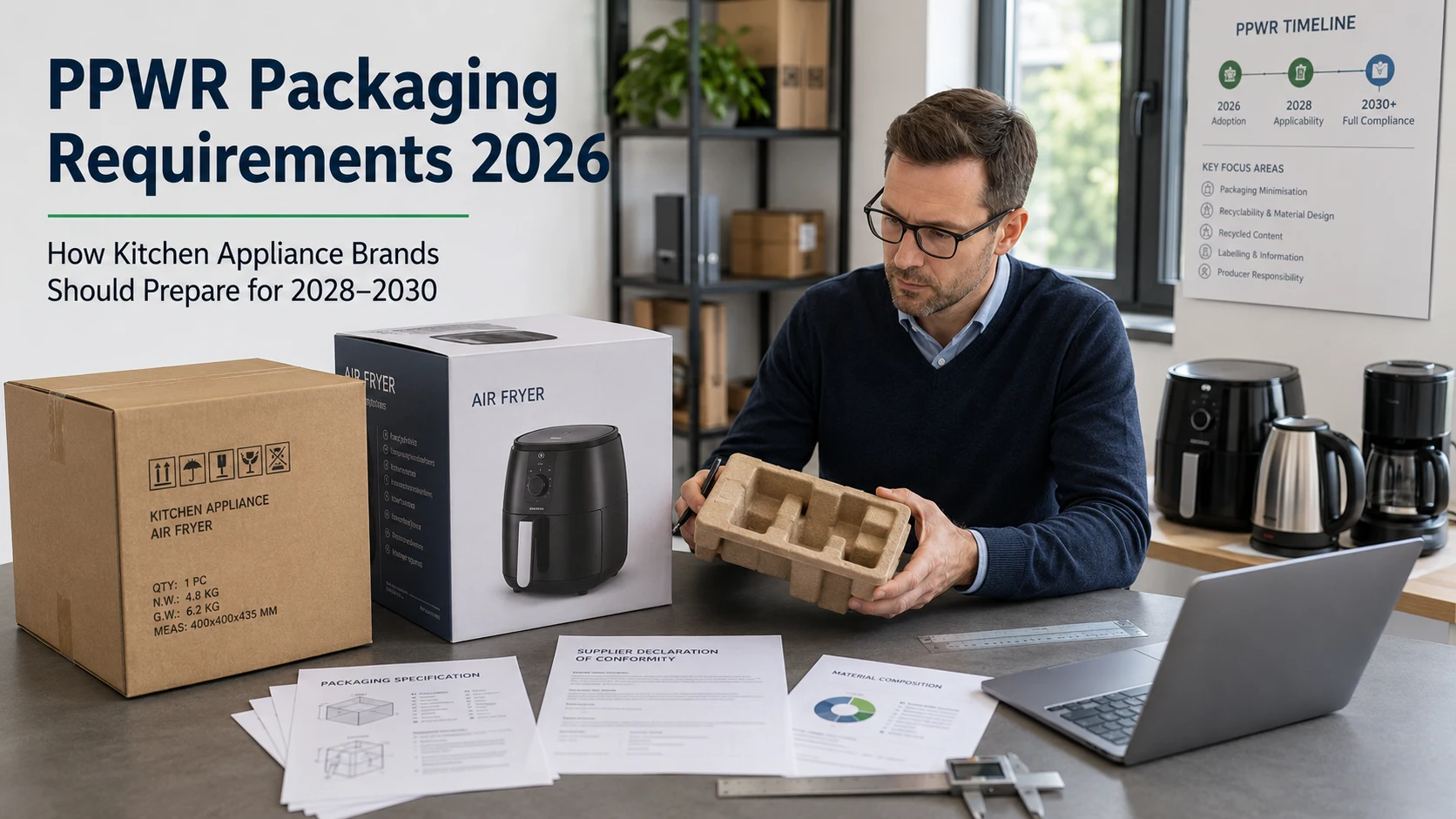
Kitchen appliance brands preparing products for the European Union need more than a general claim that a carton is recyclable. The PPWR packaging requirements 2026 create a compliance process covering packaging identification, material data, technical documentation, operator responsibilities, and future design changes. The Packaging and Packaging Waste Regulation entered into force on February 11, 2025 and generally applies from August 12, 2026. It covers packaging of every material and origin placed on the EU market.
The purchasing task is to separate current duties from 2028–2030 design milestones. Treating every future requirement as an August 2026 deadline can cause incorrect supplier instructions and repeated approvals.
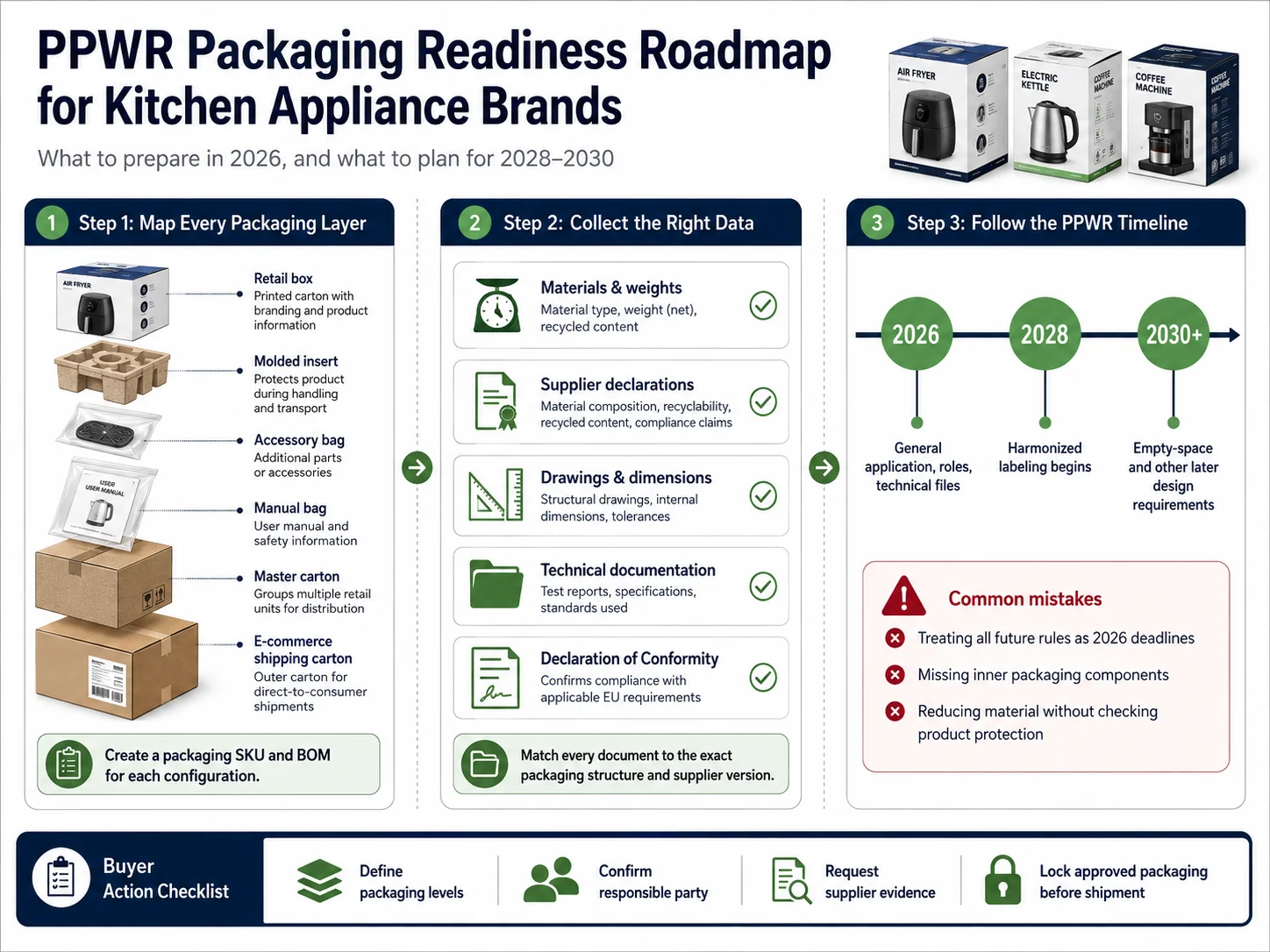
PPWR 2026 Timeline: What Applies Now and What Comes Later
Brands should distinguish current documentation duties from later labeling and design milestones.
| Timing | Main Preparation Area | Practical Buyer Action |
|---|---|---|
| August 2026 | General PPWR application, role assessment, conformity work, technical records | Identify every packaging SKU and collect supplier data |
| 2028 or later | Harmonized material labels and sales-packaging minimization milestones | Prepare material and artwork data; avoid speculative labels |
| 2030 or later | Certain recyclability, recycled-content, minimization, and empty-space requirements | Review packaging architecture during redesign cycles |
What Kitchen Appliance Brands Need to Prepare From August 2026
Create a controlled record for each packaging type. It should identify the packaging level, intended use, materials, dimensions, weight, supplier, related appliance model, and artwork version.
Manufacturers must perform the applicable conformity assessment and prepare technical documentation. Once conformity is demonstrated, an EU Declaration of Conformity is prepared for the packaging. Importers need to verify that the assessment, documents, markings, and required information are available before placing packaging on the market. These responsibilities should be assigned before mass production.
Which Labeling and Empty-Space Rules Apply Later
Not every visible PPWR change starts in 2026. Harmonized material-composition labels generally apply from August 12, 2028 or 24 months after the relevant implementing act enters into force, whichever is later. Brands should collect accurate material data now without printing an unconfirmed format early.
For grouped, transport, and e-commerce packaging, the maximum 50% empty-space ratio generally applies by January 1, 2030 or three years after the relevant implementing act enters into force, whichever is later. The regulation recognizes that irregular, fragile, or multi-item products may need protective space.
Map Every Packaging Layer Used for a Kitchen Appliance
An appliance order rarely has one packaging component. An air fryer may use a printed box, inserts, accessory bags, film, and a master carton; a coffee machine may need separate protection for its body, tank, and accessories.
Buyers reviewing a small kitchen appliance product range should map sales, grouped, transport, and e-commerce packaging separately. A retail box may be placed inside different master cartons depending on order size or sales channel, creating distinct configurations.
Build a Packaging SKU Inventory and Packaging BOM
Assign a packaging SKU to each approved configuration. The packaging bill of materials should record the component, material, weight, dimensions, supplier reference, related appliance model, and artwork version.
A shared box may support several product variants only when dimensions, weight, protection needs, artwork, and accessories remain compatible. Changes to the insert, carton size, plastic bag, coating, adhesive, or printed information should trigger review. Without version control, current artwork may be combined with an obsolete structure or material.
Determine Who Is Responsible Under PPWR
Responsibility depends on the supply chain, branding arrangement, and market role. The packaging converter may supply specifications, the appliance supplier may coordinate the finished package, and the EU importer or brand may still carry legal duties.
Separate Supplier, Brand Owner, and Importer Responsibilities
Packaging suppliers should provide information needed to assess the finished packaging, such as material specifications, component weights, declarations, and traceability references. The party responsible for the finished packaging must decide whether that evidence is applicable and sufficient.
A contract cannot automatically remove statutory obligations. Importers should confirm who maintains technical documentation, signs the Declaration, controls changes, and handles national producer-responsibility registrations.
Check Whether Private Labeling Changes Responsibility
An importer or distributor that markets packaging under its own name or trademark, or modifies it in a way that may affect conformity, can be treated as the manufacturer under PPWR.
The private label small kitchen appliance process should therefore connect brand artwork, packaging structure, material selection, and documentation. A logo change mainly affects identification, while replacing molded pulp with foam or reducing carton size may change materials, protection, dimensions, and future assessment. Review each change before approval.
Build PPWR Technical Documentation and the Declaration of Conformity
A folder of supplier certificates is not a technical file. The file should identify the packaging, explain which requirements apply, show the supporting evidence, and connect the approved structure to production.
Collect Data for the Technical File
A practical file should contain packaging identification and intended use; drawings, dimensions, and photographs; material and component weights; supplier specifications; applicable requirements and assessment methods; artwork and traceability information; and a version history.
The required depth depends on the structure. Different boxes, bags, labels, coatings, and inserts need different inputs. Evidence should match the material codes authorized for production.
Prepare and Maintain the Declaration of Conformity
The Declaration summarizes the manufacturer’s conclusion that the identified packaging meets the applicable requirements. It should link to the technical documentation and clearly define the packaging or packaging family covered.
It is not a generic company certificate, and packaging does not receive a CE mark merely because a Declaration is required. If the structure, material, supplier, use, or responsible legal entity changes, review the file and Declaration. One Declaration may cover a documented packaging family, but it should not be assumed to cover every box used by a brand.
Reduce Packaging Without Increasing Product-Damage Risk
Material reduction fails when it causes damaged products. Decisions should consider appliance weight, shape, fragile areas, accessories, sales channel, handling, and transport route.
Corrugated board, molded pulp, plastic film, EPS, EPE, and composite structures provide different protection and create different documentation needs. No material suits every appliance. Compare cushioning, moisture resistance, consumer separation, supplier evidence, and the effect of substitution on shipping performance.
Packaging minimization and the future 50% empty-space rule are different tests. Grouped, transport, and e-commerce packaging use the defined calculation, where filler can count as empty space. Trials should measure protection and occupied volume rather than simply removing inserts.
Add PPWR Requirements to RFQ, Sampling, and Production Control
The RFQ should state the appliance model, destination countries, sales channel, packaging layers, materials, dimensions, quantity, document responsibilities, artwork requirements, and permitted substitutions. Requesting this after quotation makes supplier comparisons unreliable because quoted scopes may differ.
Through OEM and ODM appliance packaging customization, buyers should approve the appliance sample, packaging sample, BOM, artwork, and document responsibilities as one package. RAF’s published workflow covers demand communication, drawing and print confirmation, sample production, mass production, packing, shipment, and delivery.
Material substitutions should require written approval. Before shipment, compare the physical packaging with the approved sample, BOM, dimensions, markings, and artwork. Use four gates: supplier approval, packaging sample approval, production release, and pre-shipment review.
How to Evaluate a Kitchen Appliance Supplier’s Packaging Support
A suitable supplier should identify every packaging component, maintain drawings and artwork versions, provide material and weight data, trace upstream sources, and notify the buyer before substitutions. It should also distinguish supporting evidence from a legal compliance conclusion.
Zhejiang RAF Electric Co., Ltd. publishes a portfolio covering air fryers, kettles, coffee machines, food processors, ovens, and related small appliances. Its public ODM/OEM process includes artwork confirmation, sampling, production, packing, and delivery, which provides a basis for project-specific packaging discussions. PPWR files, declarations, EPR responsibility, and material evidence should still be confirmed for each model and destination.
Buyers should submit the model, target market, sales channel, packaging structure, requested changes, artwork, quantity, and available material data before printing or production.
Conclusion
PPWR preparation starts with accurate packaging identification, not a last-minute sustainability claim. Kitchen appliance brands should separate 2026 documentation work from later labeling and empty-space deadlines, build a packaging BOM, assign roles, and control material and artwork changes.
Buyers can contact RAF with the model, destination countries, packaging drawings, materials, quantity, sales channel, and customization request to discuss what should be confirmed before sample approval.
FAQs
Does PPWR apply to kitchen appliance packaging?
Yes. PPWR covers relevant sales, grouped, transport, and e-commerce packaging placed on the EU market, regardless of material or origin. The appliance itself remains subject to separate product requirements.
Are PPWR packaging labels mandatory from August 2026?
Not all harmonized labels become mandatory then. Material-composition labeling generally applies from August 12, 2028 or 24 months after the relevant implementing act enters into force, whichever is later.
Does every appliance box need a separate PPWR Declaration of Conformity?
Not necessarily. A Declaration may cover a clearly defined packaging type or family when its scope and technical relationship are documented. A generic company statement should not be assumed to cover unrelated structures.
When does the PPWR 50% empty-space rule apply?
For grouped, transport, and e-commerce packaging, it generally applies by January 1, 2030 or three years after the relevant implementing act enters into force, whichever is later.
Does PPWR replace national packaging EPR registration?
No. Packaging conformity documentation and extended producer responsibility are separate workstreams. The responsible business should still determine registration, reporting, and fee obligations in each destination market.


