
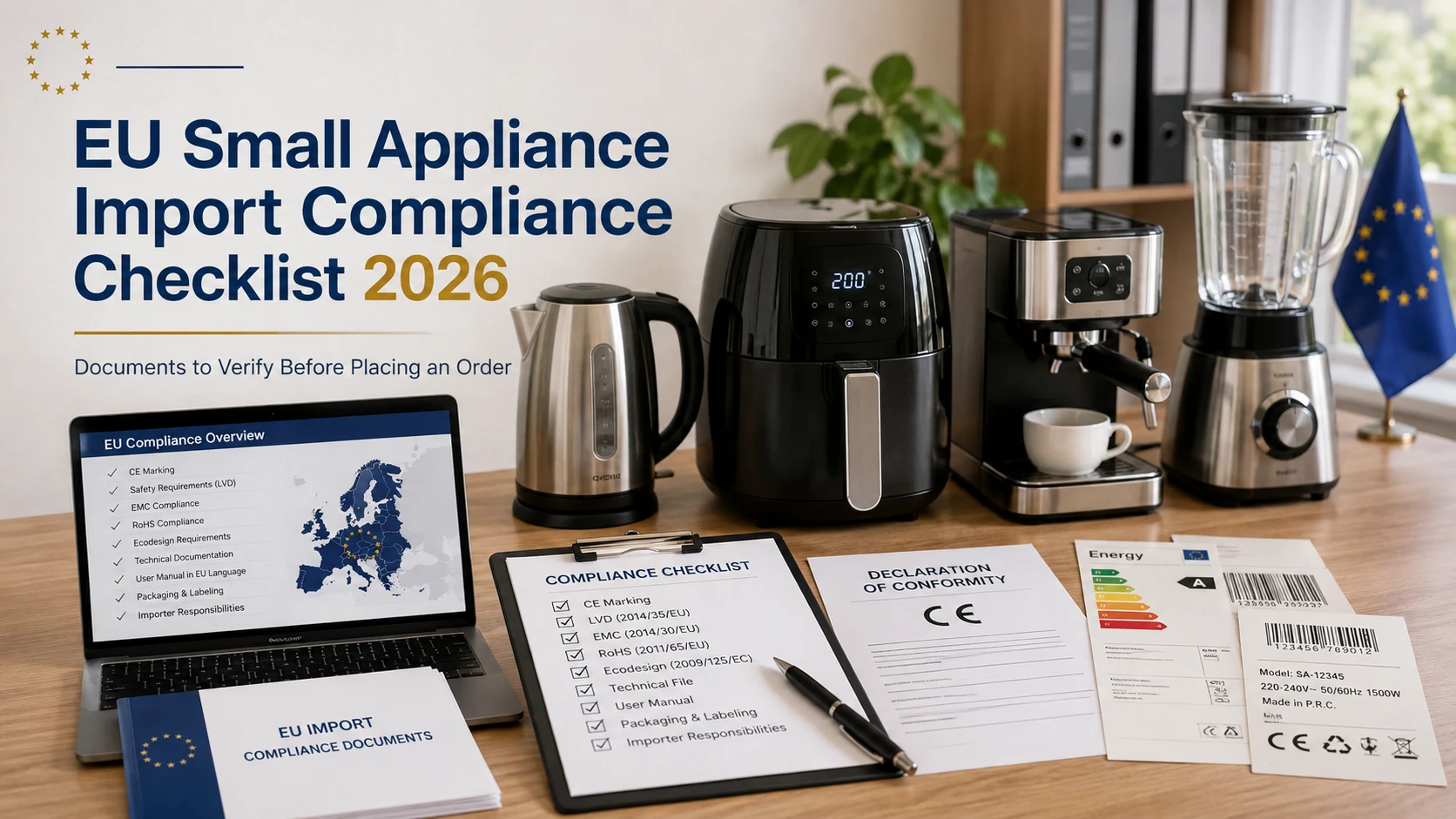
Importing a small electrical appliance into the European Union requires more than checking whether a CE mark appears on the housing. A practical EU small appliance compliance checklist must connect the exact product configuration with the applicable rules, supporting documents, labeling, instructions, and importer responsibilities. The real question is whether the evidence covers the same brand, model, voltage, plug, components, materials, and intended use as the product being ordered.
This guide is for importers, private-label buyers, distributors, and purchasing teams reviewing small appliances before sample or purchase-order approval.
Start With the Exact Product and Import Scenario
Compliance work should begin with a defined commercial product, not a catalog description. Similar-looking appliances may use different heaters, boards, plugs, coatings, or food-contact parts, changing the required evidence.
Define the Model, Intended Use, Market, and Sales Channel
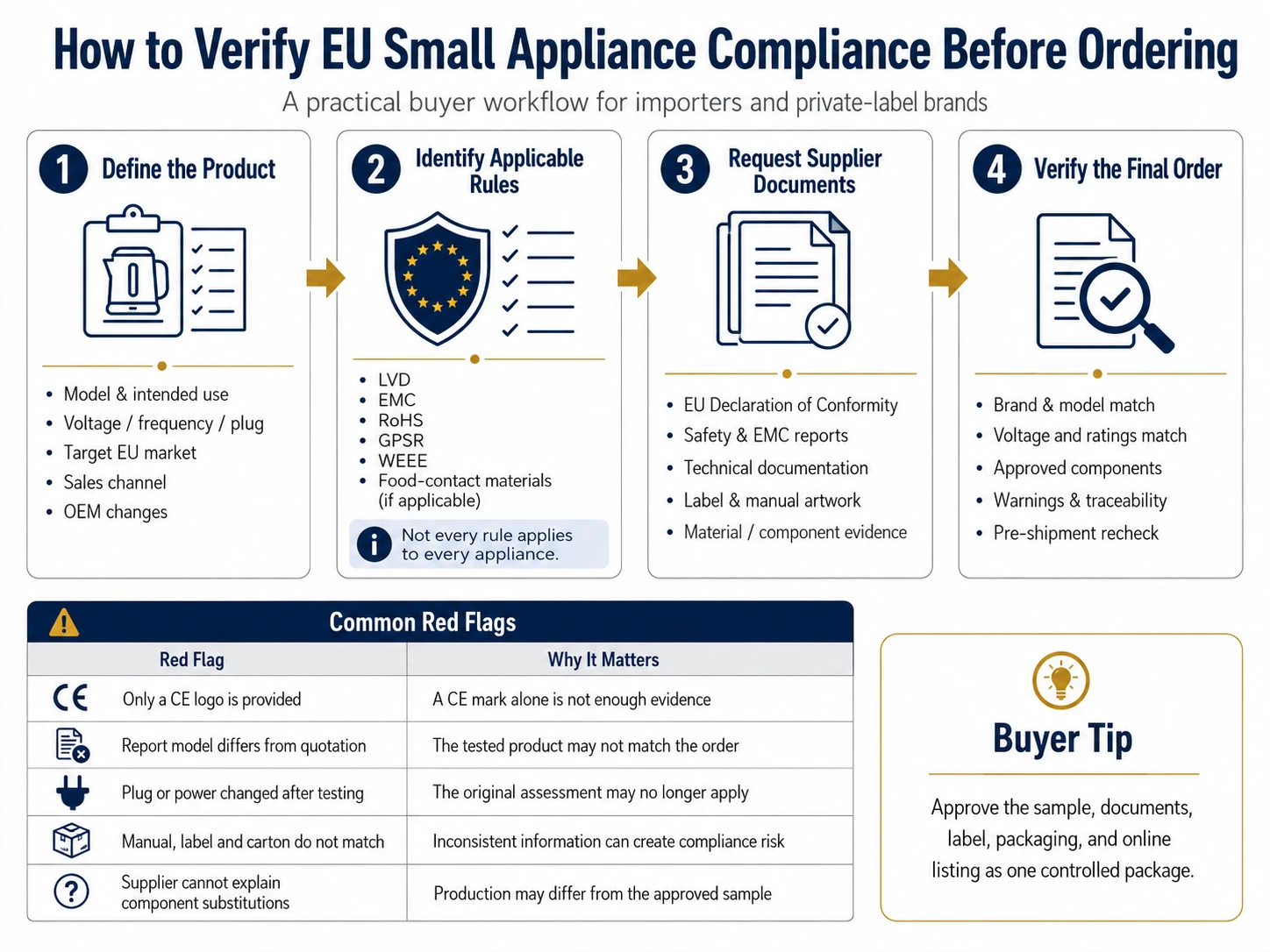
Record the model number, brand owner, household or commercial use, voltage, frequency, plug, target country, and sales channel. Also identify whether the appliance contains a battery, wireless module, pressure system, heating element, or food-contact surface.
This shows whether the tested model matches the quotation, which languages are needed, and what an online listing must display. Put these details in the RFQ.
For a multi-category order, review the small kitchen appliance product range by function. A kettle, blender, and coffee machine may all contact food or water, but their electrical and material risks differ.
Identify OEM Changes That May Affect Existing Evidence
Private-label work may change the plug, voltage, heater, motor, board, coating, resin, food-contact part, or housing. Even rebranding can affect the Declaration of Conformity and labeling responsibilities.
Before approving OEM and ODM appliance customization, request a written change list, approved components, and confirmation that existing assessments remain applicable. Decorative and major electrical changes should not be treated alike.
Determine Which EU Rules Apply to the Appliance
There is no single “small appliance certificate.” EU electrical appliance compliance is built from several requirements selected according to the product’s functions and risks.
| Requirement | When It May Apply | Evidence to Request | Main Buyer Risk |
|---|---|---|---|
| Low Voltage Directive | Mains-powered equipment within scope | Declaration, safety report, technical data | Tested construction differs from order |
| EMC Directive | Equipment that can create or receive interference | EMC report, final electronics | Board or motor changes after testing |
| RoHS | Electrical and electronic equipment within scope | Material declarations, test data | Evidence covers different components |
| GPSR | Risks and duties not fully covered elsewhere | Risk assessment, traceability data | Missing EU operator or warnings |
| WEEE | Electrical equipment placed on EU markets | Marking and registration plan | CE files are mistaken for EPR compliance |
| Food-contact rules | Parts intended to contact food or drink | Material declarations, relevant tests | Coating or plastic is not assessed |
The European Commission identifies the Low Voltage and EMC Directives as key electrical-equipment frameworks; RoHS restricts specified hazardous substances.
Check CE, Electrical Safety, EMC, and RoHS Together
CE marking is required only when applicable EU legislation requires it. It is the manufacturer’s declaration of conformity, not proof that an EU authority has approved the appliance. Products subject to several CE laws must meet all applicable requirements before the mark is affixed.
Compare the safety report, EMC report, Declaration of Conformity, rating label, and final bill of materials. Check whether the evidence covers the actual voltage, power, motor, heater, board, plug, and safety components. RoHS documents should also relate to the materials used in production, not merely another product from the same supplier.
Add GPSR, Traceability, and Online-Sales Requirements
GPSR does not replace product-specific electrical rules. Where EU legislation already covers a particular safety risk, GPSR applies to aspects and risks not covered by those rules.
For distance sales, the offer must display the manufacturer’s contact details. If the manufacturer is outside the EU, it must also identify the responsible person in the Union, together with product identification and required warnings.
Approve the product, packaging, manual, Declaration, and online listing together. Their model, operator details, warnings, and image must match.
Check Product-Specific and Market-Entry Obligations
Wireless products may fall under the Radio Equipment Directive. Kitchen appliances may need evidence for plastics, coatings, metals, seals, or other food-contact parts. EU food-contact rules cover kitchenware and food-processing machinery.
WEEE requires separate attention. Electrical and electronic equipment placed on the EU market generally requires WEEE marking, while producer registration and reporting operate through national systems.
Packaging is another workstream. The Packaging and Packaging Waste Regulation generally applies from August 12, 2026, and covers packaging regardless of material or origin.
Request the Right Compliance Documents Before Approving the Order
The key purchasing question is: “What documents should an EU appliance importer request before paying a deposit?” A CE logo or certificate image is not enough.
Verify the Declaration of Conformity and Technical Documentation
Request a draft EU Declaration of Conformity identifying the product, manufacturer, legislation, standards, and signatory. Compare its brand and model with the quotation and sample.
The importer should confirm that technical documentation exists and can be supplied to authorities when required. Under the Low Voltage Directive, importers must verify that conformity assessment was completed, technical documentation was prepared, required markings are present, and required documents accompany the equipment. A copy of the Declaration of Conformity must be retained for ten years after market placement.
Supporting records may include safety and EMC reports, drawings, risk assessments, component lists, material declarations, artwork, and instructions. Scope depends on the appliance.
Check Material, Component, and Food-Contact Evidence
Ask which plug, cord, thermostat, motor, heater, board, plastic, coating, seal, and food-contact parts are approved, and whether substitutions require authorization.
For air fryers, kettles, coffee machines, and processors, identify every part that contacts food, water, steam, or condensate. Evidence may vary by material and contact condition. A declaration for one resin or coating should not automatically be applied to another.
Approve the Label, Manual, Packaging, and Listing Together
Keep the brand, model, manufacturer, importer details, ratings, warnings, and identifiers consistent. Instructions must be understandable in the destination Member State, and importer details must appear on the equipment or, where permitted, its packaging or documents.
A late change to plug, voltage, or power can leave the carton, manual, label, and Declaration describing different products. Final artwork approval should therefore follow configuration approval.
Verify That the Documents Match the Ordered Product
Collecting documents is not verification. A genuine report may still be irrelevant to the final order.
Match the Brand, Model, and Electrical Configuration
Compare the quotation, specification, approved sample, label, manual, Declaration, and reports. If a report covers a model family, request the documented relationship between the tested model and each variant.
When brand, power, plug, housing, materials, or critical components differ, obtain a written technical explanation. The correct action may be a report extension, supplementary assessment, new testing, or rejection of the proposed configuration.
Review Test Scope and Supplier Red Flags
Read beyond the cover. Check photographs, sample description, standards, date, laboratory, page count, and critical components. Older reports are not automatically invalid, but product, legal, standard, or company changes require review. EU guidance requires Declarations and technical documents to remain current.
Red flags include unreadable screenshots, mismatched model numbers, reports for another voltage, refusal to provide complete files, unapproved component substitutions, or claims that one certificate covers an entire catalog.
Build Compliance Checks Into Purchasing and Supplier Selection
Set four gates: supplier qualification, sample approval, production release, and pre-shipment inspection. The RFQ should state the market, brand, model, voltage, plug, channel, languages, required files, EU operator, and permitted substitutions. Use the golden sample and approved bill of materials to control production.
A small kitchen appliance sourcing guide for importers can support broader decisions about MOQ, packaging, and supplier evaluation. This checklist should remain focused on market-entry evidence and configuration control.
A suitable supplier should provide model-specific records, identify the tested configuration, disclose component changes, and coordinate document revisions. Zhejiang RAF Electric Co., Ltd. lists air fryers, kettles, coffee machines, processors, cleaning appliances, and laundry-care equipment, while its published ODM/OEM workflow covers requirement communication, artwork confirmation, sampling, production, packing, and delivery. Buyers should still verify files for each model and destination.
Conclusion
EU appliance import review is model-specific. Define the product and market, identify applicable requirements, verify every file against the order, lock approved components, and recheck before shipment.
Buyers evaluating RAF products can contact RAF with the category, model, target country, voltage, plug, brand, quantity, and proposed changes. This supports document and customization review before sample approval without assuming one package fits every model.
FAQs
Is CE marking enough to import a small appliance into the EU?
No. Importers must also verify the conformity process, technical documentation, required instructions and markings, and whether the product matches the configuration covered by the evidence.
Does GPSR replace CE marking for electrical appliances?
No. GPSR complements product-specific legislation by covering relevant risks and duties not already addressed. Electrical safety, EMC, RoHS, traceability, and online-sales information may need review together.
Can one test report cover several appliance models?
Possibly, when the models are technically related and the report documents the covered variants. Differences in power, components, materials, housing, plug, and controls should be reviewed first.
Does changing the plug or voltage require retesting?
It depends on the report scope and resulting configuration. A competent technical party should confirm whether the change remains covered, needs supplementary assessment, or requires new testing.
Who is responsible for WEEE registration?
Responsibility depends on the commercial role and destination country. The business treated as the producer in that market should confirm registration, reporting, financing, and marking duties before sales begin.


